A kangaroo court, a cross-dressing Stalin, and a political execution. Laura Zlatos’ Show Trial has all the ingredients of a deliciously dark absurdist piece. The trouble? Its tragedy and absurdity sometimes feel like they're happening in two entirely different plays.

Credit: Morgan McDowell
Laura Zlatos' play about Milada Horáková finds comedy in a kangaroo court and tragedy in a political execution. The performances are sharp, but the two halves don't always come together.
Who would have thought I'd see two shows this year about a very specific moment in history: a woman with ties to an oppressive government, put on trial for her alleged mistakes, whose story invites us to compare what happened then with what could happen today?
That said, Show Trial by Laura Zlatos differentiates itself from the surprising number of small but impactful plays about historical women judged by history. It's witty, funny, and self-aware. Not that the others weren't, but under Tom Costello's direction, this one manages to feel particularly modern and exciting.
Show Trial follows the trial of Milada Horáková (Jessica Frey) in Soviet-controlled Czechoslovakia. Milada was a war hero who resisted the Nazis during World War II and later opposed the Soviet-backed regime. She was falsely accused of treason, convicted, and sentenced to death in 1950.
These are the tragic facts the show attempts to convey in a tight 90-minute “show” trial (emphasis on show), intercut with flashbacks of Milada's life for context.
On paper, I have nothing to complain about. Zlatos' writing is sharp, funny, and emotional when it needs to be. The cast does a great job treading the line between goofy and threatening. Alex Mandell, playing both the Commentator—a Monsieur Loyal type showing us what the media of the time thought—and Milada's husband, along with Brian Bock as Karel, the orchestrator of the sham, do a wonderful job connecting the two parts of the show.

Credit: Morgan McDowell
But I'm getting ahead of myself.
The show really works in two parts.
First, there's the trial: a kangaroo court where everyone acts heightened and goofy, and where most of the comedy comes from.
The trial involves prosecutor Josef (the hilarious Alex J. Gould), who masterfully plays a slimy lawyer full of insecurities and was, for me, a comedic highlight. There's also Juraj (Tom Mezger), a stereotypical Bolshevik enforcer, complete with hat and a tendency to torture and kill everyone; Antonin (Justin Ahdoot), literally just a guy who happened to be around and is brought in as a fall guy in case things fall apart; and finally Ludmila (Jessie Cannizzaro), an aspiring actress eager to be the center of attention.
That ensemble does remarkable comedic work. Their constant butting of heads and interruptions serve the levity of this part very well. The characters even have arcs and places to go instead of simply being one-note, though some work better than others.
Ludmila's arc, for example, is a good one. She gains the importance she's always wanted, realizes the pressure that comes with it, and finally rises to the occasion.

Credit: Morgan McDowell
But Antonin being awkwardly shot for seemingly no reason? I understand it as a potentially absurd, South Park-style “Oh my God, they killed Kenny!” moment, but it didn't work for me. It just felt abrupt and random.
Overall, though, this part makes the absurdity of the trial work, while Frey's Milada stays stern and serious.
Until we transition into the other half of the show.
Intercut with the trial are flashbacks of Milada's life, where we meet her friend and inspiration Frantiska (Kalusha Brutlag) and her daughter (also played by Brutlag).
These sections are much more serious and realistic, providing context for what exactly is happening and why. Again, I have no complaints about them individually. The actors do a good job, while Cat Raynor's set design and Sawyer Smith's lighting do a stellar job contrasting the absurd nature of the trial with the realism of the flashbacks.
The reds, the posters, the microphones—the set within the space works well.
It all culminates in a dream sequence where Milada meets Stalin (played by Zivkovic), maintaining the absurd tone of the trial while bringing in the serious stakes of the flashbacks. It provides a conclusion that leads us to 1968—not exactly modern day, but still—when Milada's conviction was overturned and the injustices committed against people like her began to be acknowledged.
So, I hear you.
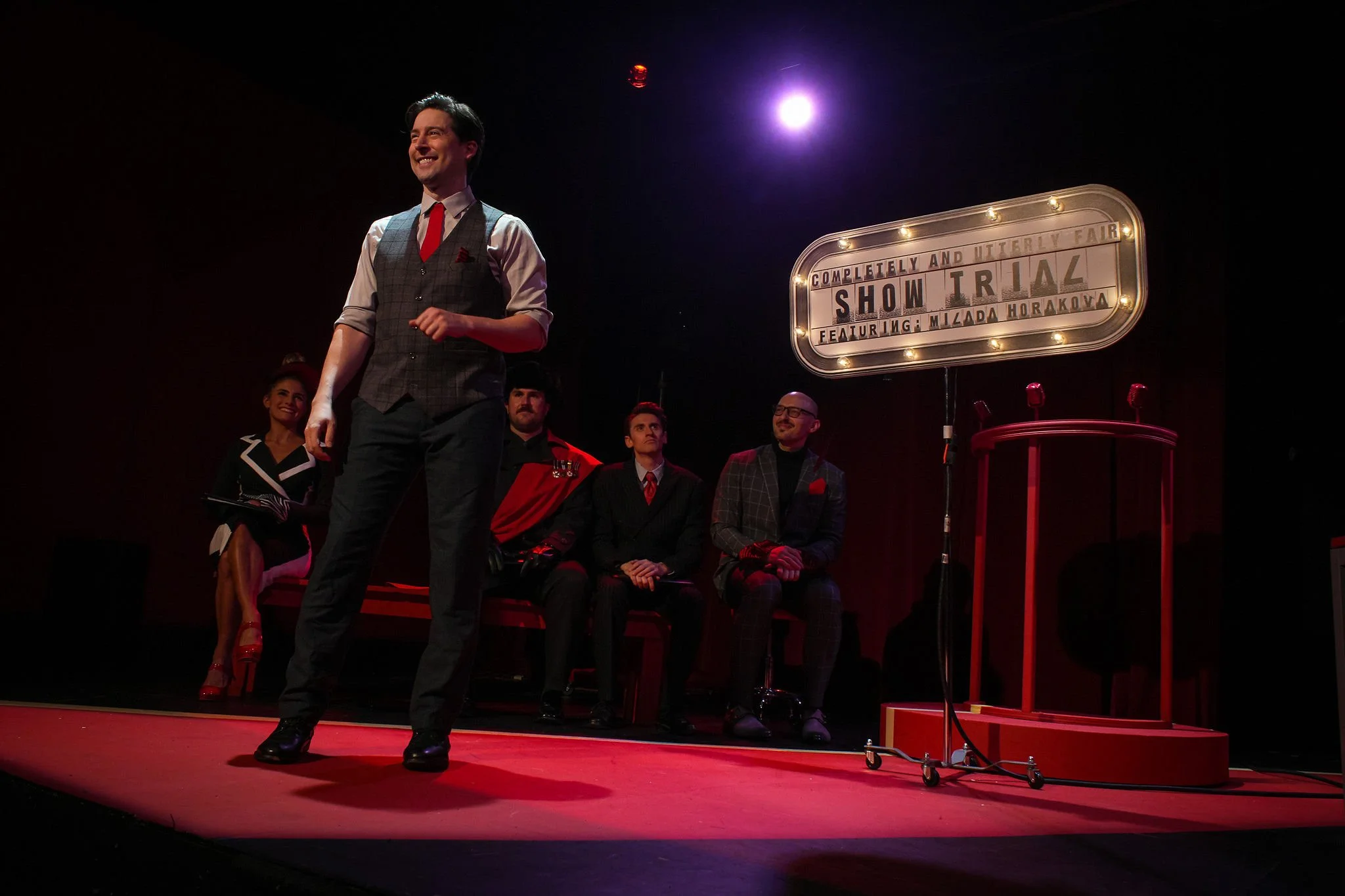
Credit: Morgan McDowell
Emile, you seem to have no qualms with this show, but you're also not particularly excited about it.
And you'd be right.
While this show is fun and explores an interesting moment in history, I don't know that the sum of its parts works as well as the individual parts.
The cast is great, and the production design works very well to strengthen Costello's direction. But at the end of the day, I don't know that the contrast works.
A fully absurdist work needs an acidity that this show almost has, but never quite reaches.
Yes, people die. Yes, Stalin is made fun of while remaining menacing. And yes, this is a real-life story. But the absurdity doesn't always serve the play.
Rhinoceros by Eugène Ionesco is my favorite play of all time, so I adore absurdism. Show Trial could be in line with it, but it stays somewhere in the middle. In the end, one leaves thinking, “Well, that's a thing that happened,” rather than feeling the haunting dose of reality that can hit so hard at the end of an absurdist piece.
The show succeeds at making you feel sympathy for Milada and making you want to look up her story, which is commendable and clearly one of its goals.
But the rest gets lost because of the serious moments. They take away from the tone, and the dissonance doesn't fully translate.
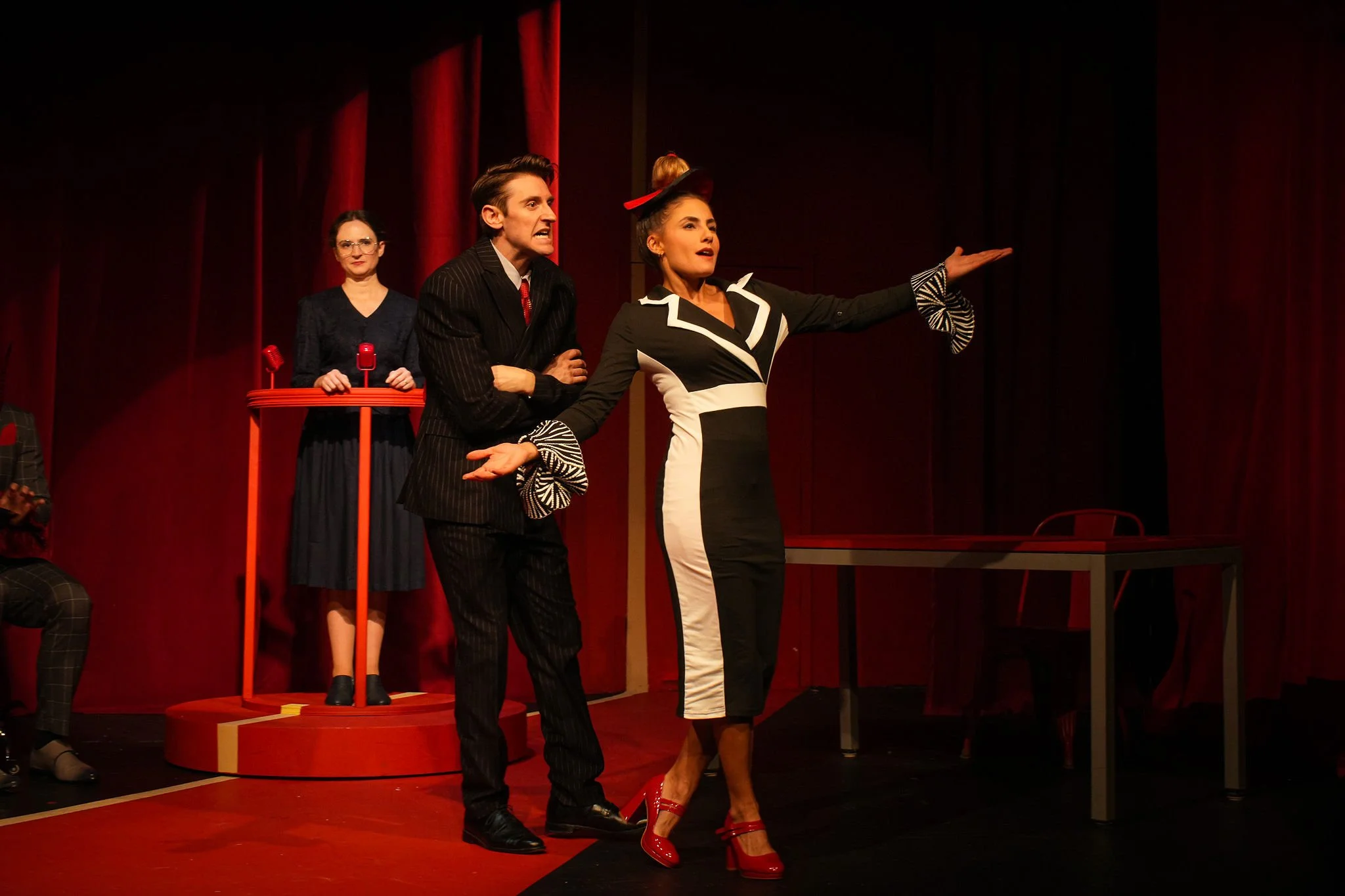
Credit: Morgan McDowell
The kangaroos that pop up periodically, for example, are on the nose and absurd, but they're not used in a way that fully commits to one approach or the other.
I guess what I'm getting at is that I wish this show were either fully absurdist, like its premise, or fully serious, like its flashbacks. Alternatively, it could keep the serious parts as a prologue and epilogue.
As it stands, it feels like Milada isn't in the same play as everyone else.
What could have us rooting for her in a Kafkaesque nightmare instead creates narrative dissonance. At least in Kafka's work, the protagonist is part of the absurd world. Here, Milada always feels outside it, even in the wild scenes where she's talking to a cross-dressing Stalin wearing a dress and claiming to be dating her daughter.
Overall, Show Trial is fun, well acted, and well produced, but falls just short of being memorable.
If its goal was to tell Milada's story—a fairly unknown story that deserves to be remembered and shared—then it succeeds. I'm glad I know about her and have learned more about the period, including the unsurprising amount of crap Stalin got up to after the Soviet Union consolidated control over Eastern Europe following the war.
Beyond that, there are other shows about similar topics, whether directly dramatizing a historical event or tackling the subject through a different plot, à la Rhinoceros. Some of those will stand the test of time more than this one.
But Show Trial isn't a bad show. It tries to be a fun, absurd time at a show trial while telling an important story. It just falls somewhere in the middle, becoming a little blander for it and leaving you hungry for more.