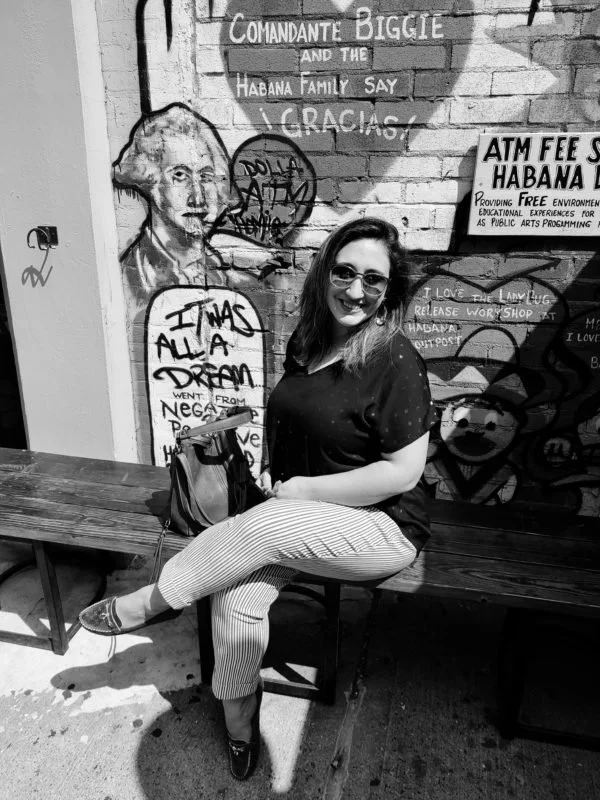
An Interview With Rachel Lin
Any type of play about family dynamics tends to make me uncomfortable. It’s a me thing. They’re some of the most vulnerable and highly sensitive material that an artist can share with an audience. I’m always afraid that this type of play will unlock emotions in me for all to see in the audience. So, as a practice, I tend to steer clear of performances of those themes.
BUT, when I saw an email about Rachel Lin’s play - I felt this, for lack of a better word, cosmic pull toward her. I’m curious if, at the end, readers will feel the same as well. I wanted to run and hide from a piece like this, but I just couldn’t. Deep down, I really wanted to know Rachel’s story, however emotional it made me. I believe it’s because Rachel Lin strikes me as someone who is deeply at peace with all parts of herself. I think all of us are trying to arrive at such a place where we have the courage to say, this is who I am. This is what I’m about. This has been my story.
The plot centers on a woman who, as a young adult, receives a Facebook message from her father whom she had never met.
STEPHANIE: I’ve always found social media messages a little unsettling, even when they’re well intentioned. There’s something inherently intimate about a stranger crafting a personalized message and suddenly having direct access to you. It can feel almost invasive, like someone stepping into your home uninvited. Maybe that’s not a universal feeling, I don’t know. Did working on Dear John change how you think about visibility online? If so, how?
RACHEL: Oh, absolutely! This piece takes place in 2011, and social media was still pretty nascent. Instagram had only just started becoming a thing at that time. I’m an elder millennial, so I remember getting my first at-home computer. Growing up, digital space was thought of as personal space, which isn’t really the case anymore. Being able to be “found” is certainly a blessing and a curse in the world we are currently living in.
STEPHANIE: What was the inspiration or impetus for this piece? I was really struck by its premise in a way that I can’t quite articulate. Were there questions you were trying to answer by writing it?
RACHEL: This piece is based on a true story. I didn’t know my father at all growing up, and when I was 22 he Facebook messaged me and started writing me letters. I never wrote back, but after five years of this he wrote that he was really sick. It was then that I bought a plane ticket and decided to go meet him for the first time.
On the flight over, I thought to myself, “I’m a grown woman about to meet her father for the first time.” It was weird to meet someone who was basically a stranger but happened to be family. I think I had the idea that I should tell this story someday during that plane ride.
When I started making this piece, I was thinking a lot about happenstance. It felt like a lot of things had to fall into place for these events to unfold exactly as they had, and I was interested in that. I was thinking about the way global forces and shifts, like China’s open door policy or the advent of Facebook, shape personal lives.
But now that I’ve been with this piece for five years, the real question I think I was trying to answer is this: why is it so difficult to talk to my family? Why does having a conversation feel like an impossible task?
STEPHANIE: Was there a part of creating this work that scared you or felt too vulnerable, but you felt compelled to include anyway? Where did you have to let go and allow the work to say something about you that you maybe weren’t ready to share or claim?
RACHEL: So much! When I was younger and cared a lot about what people thought of me, I worked really hard never to advertise anything about my home life. I grew up below the poverty line. We lived in a basement apartment, and many other parts of my identity felt embarrassing to me.
There is absolutely nothing wrong with any of those things, but for many years I worked hard to distance myself from those parts of myself. Whatever it was that made me feel that shame is something I had to let go of, along with revealing the shallow, petty, insecure parts of myself that felt that shame in the first place.
STEPHANIE: Family separation, whether it’s being pulled apart, finding one another again, or never fully reconnecting, remains a deeply personal wound. It’s something we don’t often talk about openly, even as we claim to value difference and understanding. For those who may be wary of the feelings this play could surface, what do you hope they gain by choosing to see it anyway?
RACHEL: This is such a beautiful question. The first thing I would hope is that they take care of themselves. That is definitely the most important thing. But if they decide to come, I hope they leave feeling affirmed in their choices, whatever those choices may be.
I think we are all just doing the best we can. And sometimes we just have to laugh about it.
STEPHANIE: I found this component of being undocumented in Chinatown so fascinating. In broader conversations about undocumented immigration, we almost never hear about this population. Why do you think that is? What does highlighting the challenge of being undocumented in Chinatown add to the stakes and tension of the play? Does Chinatown function almost like an invisible character? How does the setting shape the play?
RACHEL: A big part of the lack of narrative around this population might be the language barrier. Part of the strange confluence of events that had to happen for both this story and this show to exist is that, while I am of Chinese descent, English is my first language.
The other reason could be cultural. In my community, it was frowned upon to air one’s dirty laundry. Growing up, I heard very few stories about personal struggle. It was always about whose son was going to Harvard or how so-and-so was a doctor now.
That said, Chinatown is a huge part of this story. Once we moved to America, I became a latchkey kid. I always say that Chinatown raised me. In many ways, I learned how the world worked by spending weekends at my aunt’s garment factory or at my mom’s store on Canal Street.
It was the late 90s, and there were a lot of rules that I could see the adults around me operating within. I don’t know that I completely understood them at the time, but they have certainly shaped the stories I am interested in and the story I am telling.
STEPHANIE: How do you protect yourself when creating something so confessional and emotional? I’m a very sensitive person, so I’m really curious about this answer.
RACHEL: Yeah, I used to struggle with this as well. When I think of the work that I really love and that really moves me, it is usually deeply personal. I’m thinking of artists like the Bengsons, Heidi Schreck’s What the Constitution Means to Me, and the work of my friend Zaza, Diana Oh. Their work has made a deep impact on me.
So I try to hold on to that when I feel scared. I remind myself that making art is an act of generosity. I also remind myself that not everyone will like it, and that’s okay. Even if just one audience member feels like they have been seen, it was worth it.
STEPHANIE: In terms of the themes and healing, what do you think you understand now that you maybe didn’t before making this piece?
RACHEL: Every time I sit down to work on this show, I want so badly to make a version that is simple and elegant. And every time, without fail, it ends up a complete mess.
I’ve had to learn to accept the mess. It’s just more fun that way.
STEPHANIE: This play takes place when the character is a recent college graduate. How does that stage of life shape the story, versus if the character were younger or perhaps married with children?
RACHEL: Right after college, I had every conviction that I was a grown up and that the real world was going to be a certain way. I thought I knew who I was and what I wanted.
The truth was that I knew absolutely nothing. And maybe it’s just the era when I came of age, but my jadedness was at an all time high. At the same time, I wanted so much.
That specific friction feels very early twenties to me. And that’s who I was when I started getting these letters from a stranger with all these opinions about who I should become.
STEPHANIE: Explaining complicated family dynamics to friends can be difficult. If there were one aspect of this kind of family dynamic that you wish people understood without you having to explain it, what would it be?
RACHEL: Interesting. I don’t know that I’ve ever thought about this before. Maybe something about over self reliance.
In my experience, not having a lot of reliable adults in my life made me overly independent at times. I make a lot of contingency plans. I hate asking for help. All things I am working on.
STEPHANIE: Some audience members might see themselves as the daughter, the father, or even as someone who has unanswered messages they cannot bring themselves to respond to. What do you hope lingers with them after the performance?
RACHEL: You can make a show about it! Just kidding. Don’t do that. Only a very troubled person would do something like that.
I hope they leave with the question, “How do I want to be received by that other person?” And this is so corny, but also, “Can I receive myself that way?”
STEPHANIE: This play includes moments of levity and laughter. Tell me about your relationship with comedy.
RACHEL: Unrequited! Huge fan. Would love for her to call me sometime.
But really, I don’t think I could tell this story without laughing at some of the absurdities. Life writes the best jokes.