Beauty Freak Review: A Bold Play About a Filmmaker Entangled with Nazi Power
A visually striking, sharply directed production, Beauty Freak follows a brilliant filmmaker whose rise is tied to one of history’s most dangerous regimes, forcing us to confront the cost of ambition, complicity, and the stories we tell ourselves to justify both.
Beauty Freak, according to the playwright’s note in the program, is a show ten years in the making. Much of that work and care is evident in this production. From playwright, producer, and actor James Clements, who makes a playful appearance as Walt Disney, comes a show centered on a very specific figure of the Third Reich: Leni Riefenstahl. Leni was a filmmaker and artist who, while considered talented and even groundbreaking by her peers, remains widely criticized for her propaganda films tied to the Nazi Party, her relationship with Hitler, and her repeated defense of her actions with variations of “I didn’t know.”
Beauty Freak is entirely her story. As a result, much of the pressure falls on Baize Buzan, who plays Leni. It is a demanding role that spans a wide emotional and moral range, and Buzan rises to the challenge.
The play opens with a meeting between Leni and Goebbels (Peter Coleman) following the success of her film Triumph of the Will, often described as one of the most effective propaganda films ever made. Hitler has commissioned her to cover the 1936 Olympic Games, and the two discuss how she should proceed. It is a strong opening scene that sets the tone for the rest of the show. Coleman delivers a controlled, chilling performance as Goebbels, slowly losing composure as Leni gains the upper hand. At the same time, the scene establishes the play’s central tension: Leni’s love of art and need for funding, and the increasing moral cost of aligning herself with the regime that enables her success.
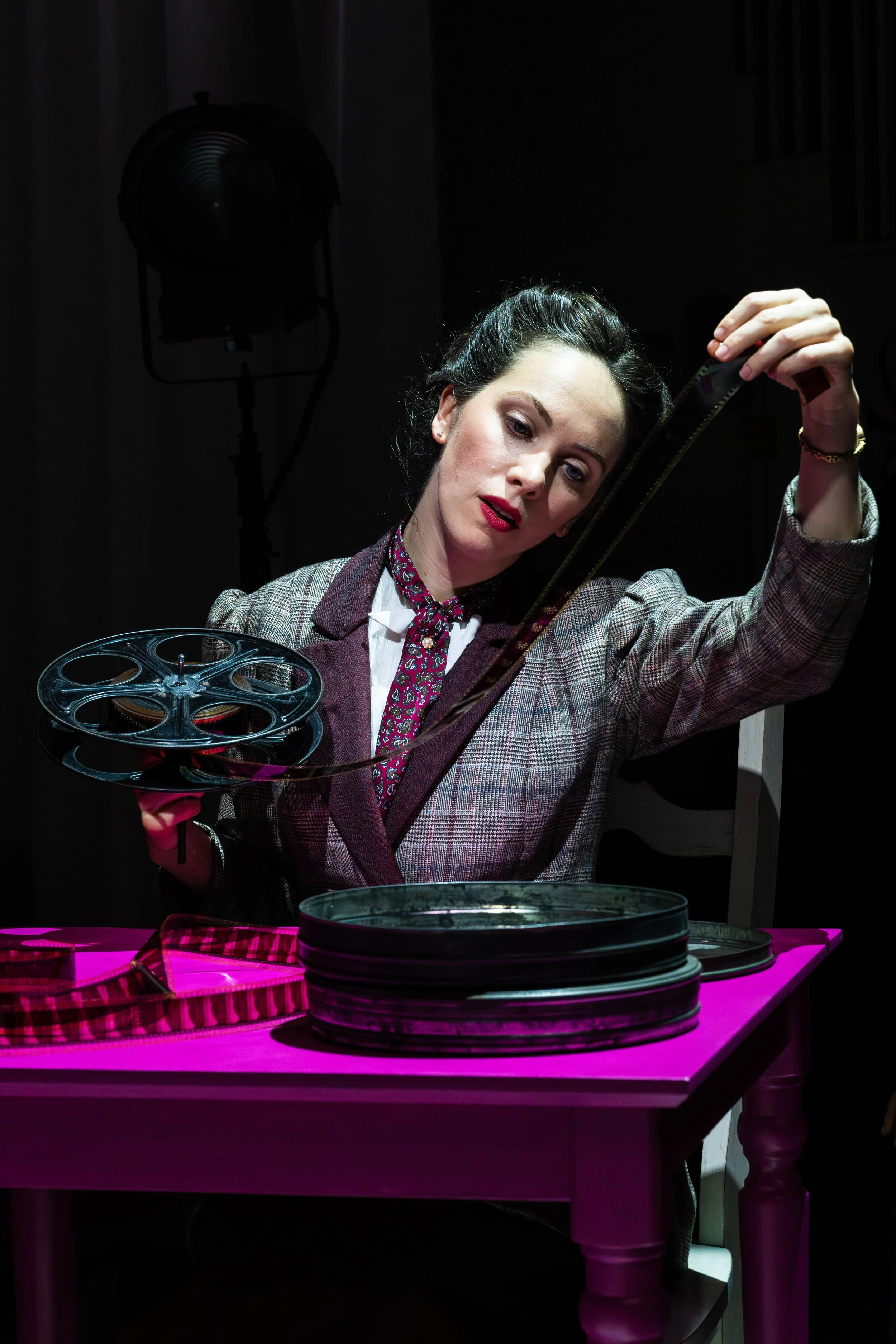
Baize Buza as Leni Riefenstahl. Credit: Alexia Haick
Clements uses this opening effectively to introduce the play’s central themes, and director Danilo Gambini elevates them through precise and cohesive staging. The technical elements stand out. Lighting design by Yung-Hung Sung, sound design by Liam Bellman-Sharpe, and set design by Suzu Sakai blend seamlessly. Transitions are fluid, moving from flashes of light to sound cues to projections with impressive precision. The result is a production that feels tightly orchestrated and visually striking.
The staging at The Cell Theatre enhances this effect. Presented in an arena format, the actors remain on stage throughout, stepping aside as scenes shift. Despite the constant presence of the ensemble, focus is never lost. The opening scene illustrates this well. It begins in German with distorted lighting and sound, then shifts abruptly into English with a burst of light and clarity, a moment of technical and theatrical control that is genuinely impressive.
As the story develops, we are introduced to Ernst (Keith Rubin), a longtime collaborator and friend of Leni. He serves as a moral counterpoint, wary of the Nazi Party and more aware of its dangers, partly because of his Jewish wife. His relationship with Leni becomes increasingly strained as the war approaches. Through their interactions, the play explores Leni’s rise and the ethical compromises that accompany it. It raises questions about artistic ambition, complicity, and self-deception. Is Leni truly unaware of the political implications of her work, or is she choosing not to see them?
The play leans into this ambiguity. As Clements suggests, “there are many Lenis.” The monster, the pioneer, the artist, the feminist. The production attempts to hold all of these identities at once, and for the most part, it succeeds.
The design choices reinforce this complexity. Costume design by Stephanie Bahniuk replaces traditional Nazi imagery with bright neon pink armbands and accents. This stylization avoids direct replication while still engaging with the subject matter. The pink contrasts with otherwise naturalistic costumes and props, creating a visual language that is both striking and thoughtful.
The supporting cast moves fluidly through multiple roles as Leni’s circumstances shift. Buzan navigates these changes with control, moving from confidence to denial to panic to justification. It is a layered performance that captures the contradictions of the character.
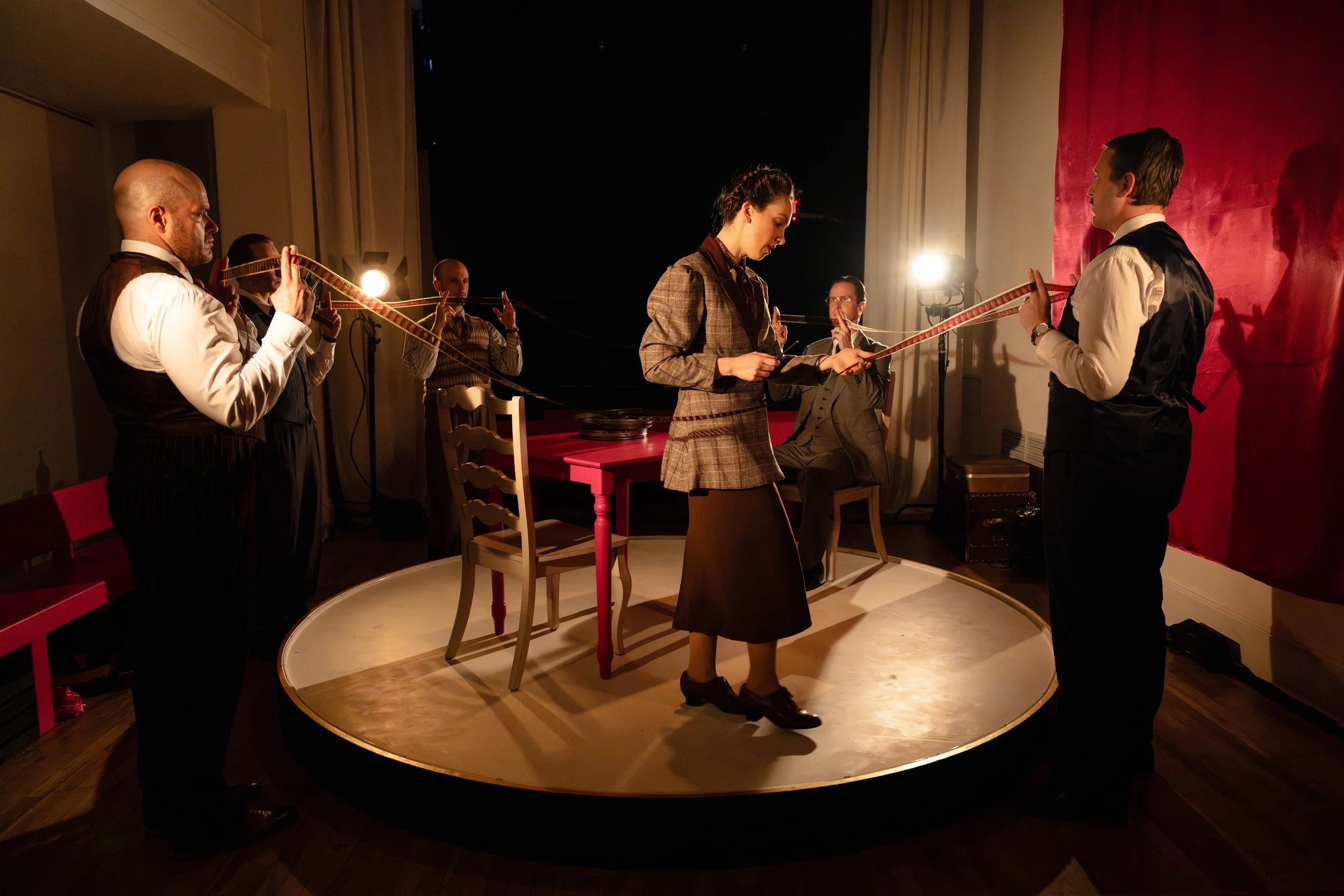
The company of Beauty Freak. Credit: Alexia Haick
The production also sparks curiosity about the real Leni Riefenstahl. Her life extended well into the 2000s, and her legacy remains deeply contested. The play encourages further exploration, including her film Olympia, which was both widely praised and deeply controversial.
There are, however, a few weaknesses. The most significant is the play’s apparent attempt to make Leni sympathetic. While the script presents her struggles as a woman in a male-dominated field and emphasizes the limitations placed on her, these arguments may not resonate with every audience member. Her justifications, including her claim that she is simply an artist navigating a difficult system, can feel insufficient. Rather than eliciting sympathy, they may reinforce a sense of moral distance.
This response may be intentional. The play invites the audience to grapple with discomfort and judgment. Still, the balance between complexity and sympathy does not fully land for everyone.
Ernst’s character presents another challenge. While historically grounded, his relationship with Leni lacks clarity in its emotional intensity. At times, they seem like romantic partners, while at others they are simply longtime collaborators. The ambiguity extends to the play’s conclusion, leaving questions about his ultimate choices and feelings unresolved. A more defined arc might have strengthened the emotional impact of their relationship.
A minor issue lies in the marketing. The title Beauty Freak and the visual design of the poster suggest a more irreverent or provocative tone than the play delivers. While the imagery is striking, it does not fully align with the production’s content.
Despite these concerns, Beauty Freak is a compelling and well-executed production. It is thoughtfully directed, technically impressive, and anchored by strong performances. More importantly, it engages with questions that feel relevant beyond its historical setting. How far would you go to achieve your ambitions? What compromises would you justify? How often do people ignore what is in front of them when it benefits them?
For audiences interested in intelligent, historically grounded theater, in the vein of Leopoldstadt, this production is worth seeing. It is a show that lingers, prompting reflection long after the final scene.