“Today we are here to celebrate one of the beloved, one of the fallen,” chokes local Brooklyn rapper Dupree G.O.D., head bowed and hands folded in prayer. He’s flanked by the moral support of friends in suits and sunglasses, holding bouquets they place gingerly on the subway seats in front of them. “It got us through thick and thin. It got us through all the Showtimes.” He invites the L’s afternoon passengers to join him in a moment of silence, which is quickly curtailed by one of his henchmen’s mournful wails.
This humble funeral for the Metrocard, broadcast on Tiktok December 15th, was more wake or shiva than main event. That came two weeks later on New Year's Eve, when Dupree led a much larger procession through the turnstiles. Dozens came dressed in black and the departed’s merch, one carrying a yellow cake with cards for candles, one sporting a dark veil decorated with the deceased’s likeness. “Swipe swipe!” Dupree called. “Swipe swipe,” the crowd responded, in the style of “and with your spirit.”
The swath of mourners had attracted hundreds by the time they emerged in Washington Square Park, Dupree at the helm with a framed poster advertising the “farewell service” in cursive, Metro himself depicted in a (controversial!) Mets cap. The ceremony began with a spreading of alarmingly nondescript “ashes” from an urn, sending the fallen’s remains (?) home down the grate beneath the arch. Dupree delivered another touching eulogy while attendees followed along on actual Xeroxed programs, one of them cutting in with “swipe swipe” or “hallelujah!” every few lines. “It survived bent corners, cracked magnetic strips, being pulled out of our wallets like it owed us money…which some of our cards did.” There was a chorus of “this little card of mine, I’m gonna let it swipe,” cards held up like lighters in droves.
The screams of “WHY??!!” and pallbearers collapsing to the ground in sobs might have appeared facetious, but the Metrocard’s recent death really was a loss for many New Yorkers. That impossibly thin piece of plastic sat in our wallets for 32 years like a lover’s photo in a locket, a technological marvel compared to the tokens, dimes, and nickels that preceded it.
Metro was born in the subway capital of the world, Fidi, in January 1994. An NBC News clip from his zeroth birthday finds vintage passengers, all wearing the biggest ties and glasses known to man, flocking like wise men to Jesus (but the scene 100% smelled worse).
Beaming MTA employees with Metrocard hats and megaphones welcome them like Disney cast members working a rollercoaster, paps snapping incredibly boring photos as riders learn swiping technique. (Masters of the craft hold up scorecards in the Youtube comments. “That lady pissed me off, swiping that card like that,” one hater announced. Stop projecting your Swiper trauma, Dora the Explorer.)
As usual, the PATH already had a “high-tech fare card,” but got none of the credit. “You don’t have to fumble and have change and wait around and what have you,” explains a Hoboken commuter in a trench coat that could actually convincingly fit three other people. They cut the cameras before he can add, “Fucking idiots.”
Finally, a reporter with five-inch tall hair informs us that “by the end of 1997, all 469 subway stations will be using this card.” She eyerolls, “But…then again, that’s a promise from the MTA.” Clock it, Magee Hickey.
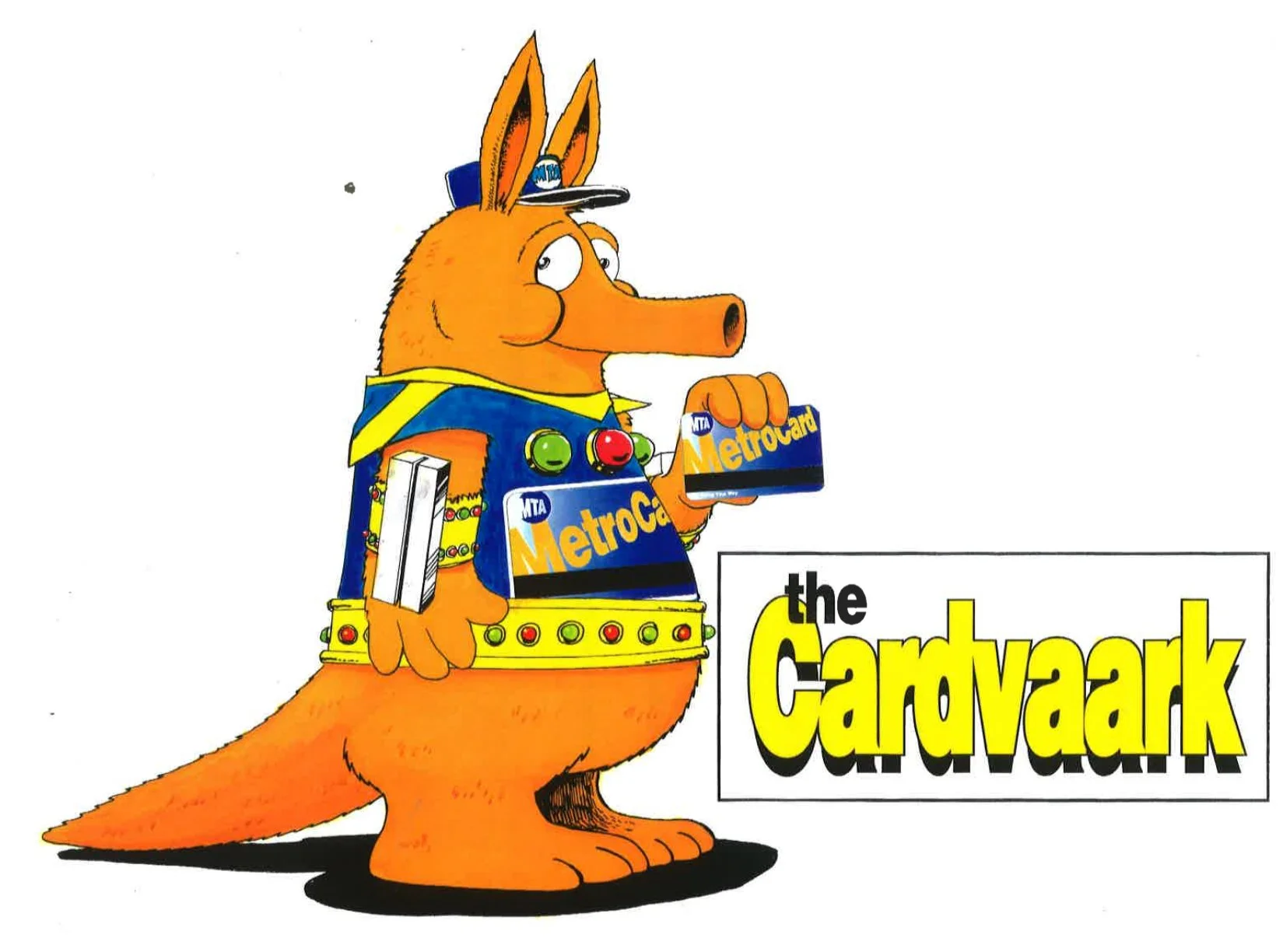
The unnecessary hoopla surrounding the Metrocard’s launch at first struck me as confusing: were people really that bored in the 90s? They had email and $5 footlongs and step aerobics and not for nothing, had seen a credit card. But the out-of-context whimsy clicked when I discovered would-be mascot Cardvaark.
Cardvaark was canonically NOT an aardvark, but a “shy and tech-savvy anteater,” which is a different animal, geniuses. (Don’t say Magee didn’t warn you: our wizard, the MTA, lies.) The orange legend wore an MTA hat in contrast with otherwise outrageous drip (a jewel-encrusted polo, matching gold bracelets with card swipers attached so he could steal your money, and no pants). They booked an unnamed actor’s big break playing him in subway stations (assumedly going Winnie-the-Pooh full-frontal). Cardvaark was “very cute,” recalled a New York Transit Museum curator. “He [had] sort of a knowing look: ‘I know you’re gonna use the Metrocard.’” (Bitch, you don’t even “know” what animal you are.)
But in a haunting twist of events, just days before the festivities, Cardvaark was, to quote the New York Post, “put to death.”
Even transit historians have yet to solve Cardvaark’s murder. My money is on Shakespearean assassination by Arthur, whose tragic flaw was assuming Cardvaark was a fellow power-hungry cartoon aardvark (take that library card to the zoology section, idiot). But another theory suggests that sketches of Cardvaark (aka his nudes) were leaked by a Newsday reporter and the New Yorkers who encountered them were like, “it’s on sight for that orange bitch.” Yet another camp claims an exec called Cardvaark a “silly waste of money” (maybe don’t dress him head-to-crack in precious gems then).
Regardless of how or why, Cardvaark was six feet under eating ants, but his fanciful legacy lived on in the MetroCard’s debutante jamboree. People were losing their shit over this thing: instead of hauling around leprechaun sacks of gold, they could finally fill that weird empty slot in their cardholders. There were free transfers, train to bus or vice versa, to offset the horrors of Greek epic commutes. And the golden ticket worked anywhere: not just on the PATH, but on the Staten Island Railway, the JFK Airtrain, Westchester’s Bee-Line buses, Nassau County’s NICE buses, and the MTA’s magnum opus, the Roosevelt Island tram.
For many, the magic of the Metrocard faded over the years as we contended with his back-pocket butt sweat streaks, his ill-timed “see agent” pranks, his sinister refill vending machines with their 1994 touch screens (the least fun arcade game of all time). But for others, the thrill lives on: namely, Miles Taylor of public-transit-adventure Youtube channel Miles in Transit (named perfectly for his profession, but narrowly missed being born Miles Teller: a trade-off). Miles and his public-transit/urban-planning-expert pals broadcast their ridiculous train/bus/kayak/seaplane journeys (i.e. crossing Canada by bus, riding every light rail system in Denmark) to almost 100k subscribers. And as one of several tributes to Mr. Metro, they ventured to discover just how far he could possibly take them.
The voyage of course begins at Grand Central at 1:30am, where Miles and his friend catch the Metro North to their starting line in Brewster. There is literally no one else on the 1:56 to Brewster except for the person who will obviously pop out to murder these boys. And yet, they pass the time SLEEPING in high-tech noise-cancelling eye masks, then at 3:39am descend into the darkness of a deserted train station and pick up sausage-egg-and-cheeses. “We’re crossing a body of water!” they chirp gleefully from somewhere in the Blair Witch black abyss the camera’s capturing. They then, I swear to God, walk TWO HOURS along a trail in the middle of the woods to a bowling alley parking lot, where they wait for the bus from Spongebob’s Rock Bottom to pick them up. Men: getting sausage-egg-and-cheeses instead of getting murdered in Brewster since 2025.
Courtesy: Columbia University
To my bewilderment, their Bee-Line bus actually arrives and stops, then takes them another hour to White Plains where they’ll hop another bus for deadass 57 more stops. They jump off in the northern Bronx and immediately rip several flights of stairs to catch the 4 / 5. (If I ate a sausage-egg-and-cheese at 3:39am and then did this shit, my intestines and ass would explode.)
You’ll never guess where these mofos dismount the 4 at 9:30. BACK AT GRAND CENTRAL. I repeat: back where they started eight hours ago. “We’re in great positioning for the 7!” Miles’s friend cheers as they begin their plunge into the Earth’s core. I have to admit I’m also fond of the Grand Central 7 platform/bunker: it’s chic and French in the sense of “we have the Catacombs at home.”
The 7 takes them to the F to the E to the F AGAIN, an average day in Queens. At least their next stop is a bucket-list destination: Long Island’s westernmost Hyundai dealership, infamous for “bait and switching” reviewers with the false promise that they can test drive an Ioniq 6 (fucked up).
In the evil Hyundai parking lot, the boys grab a NICE bus to another NICE bus (neither of which are nice) to a Suffolk County Transit bus, which they can apparently pay for by exchanging their Metrocards for a free piece of paper, a loophole that will catapult them (like sort of almost) into the Hamptons. Another couple of hours that would’ve sent me into ego death and before 3pm they’ve reached the promised land, Patchogue. All for $2.90! A steal!
I don’t know who the fuck else is doing 14-hour Metrocard odysseys from Brewster to Patchogue. But while supplies last, you certainly can! (Warning: you will be stuck in Patchogue forever because the Suffolk County Transit free piece of paper rule does not work in reverse and is a trap. Cry about it.)
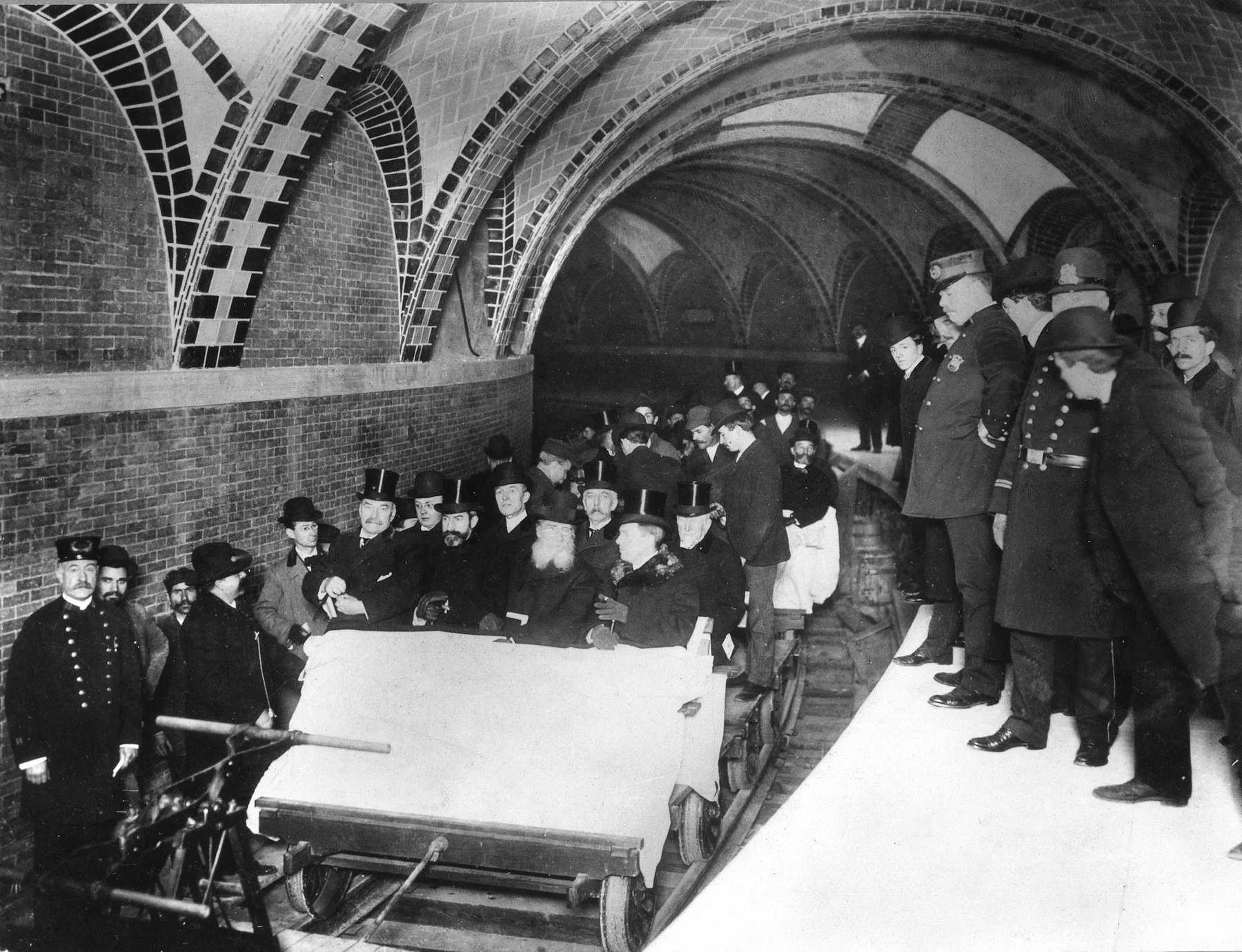
When the subway itself made its debut in 1904, New York had no buses (seems way easier to invent but okay). There was no Metro-North, and the LIRR was a choo-choo train used to carry news from England as part of a relay team including a sleigh. Basically, if you wanted to travel a hundred miles from the 10-year-old village of Brewster to the oyster farms of Patchogue, your best bet was a horse (honestly sounds way better than five trains and five buses).
In those days, subway fare was a five-cent paper ticket (quickly scrapped in favor of raw nickels). Buggies ruled the streets, election results were announced via a bat signal from the top of the New York Times building, and farting in church had just been made illegal. Still, the concept of the subway was pretty much set when it opened. That nickel would take you from City Hall to the Bronx, and it would for almost 50 years.
In 1948, the nickel became a dime—to be fair, there were now multiple lines and routes and even buses (which is how you knew it was the future), plus you could now get to Brooklyn or Queens without a boat (sorry Staten Island, boat only forever). Despite those perks arguably worth five more cents, 12% of people were like “no” and straight up walked.
COURTESY: NARA; Getty
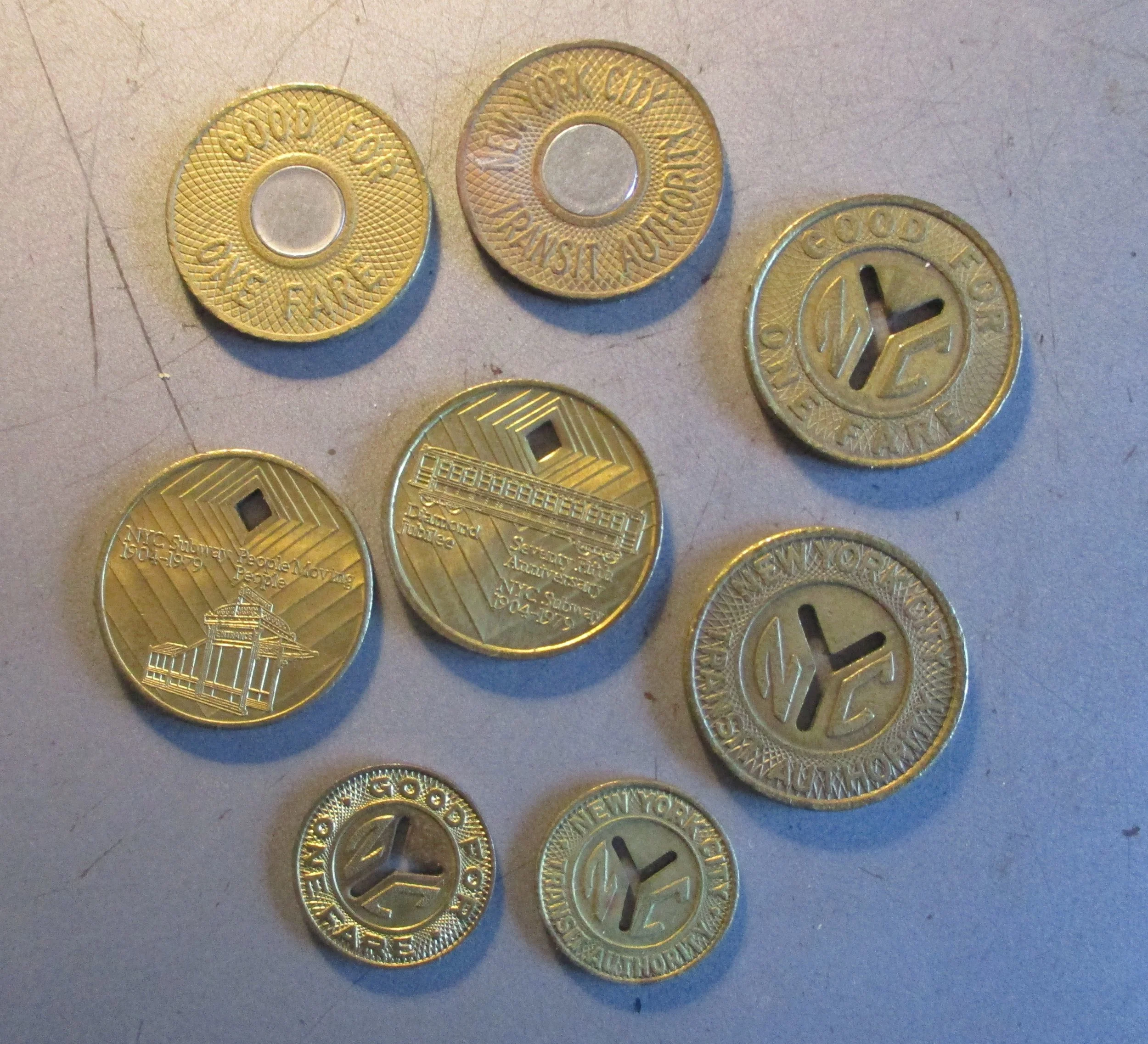
When it came time to jack the price up again in 1953, the “NYCTA” wanted to keep it a single coin, but they’d learned their lesson and knew making it a quarter would cause World War 3. Enter the 15-cent Chuck-E-Cheese token, which you could not even trade for tickets or prizes. Wtf.
As a weird flex, subway tokens were punched from solid brass, which I feel like costs more than 15 cents. Now that they’d coined a new coin, the MTA’s ancestors were free to hike the fare like it was a 3am Brewster forest (with the caveat that the “no” crowd would hoard tokens just before the increase every time). Prices famously tended to stay in line with the cost of a slice of pizza: by the time the Metrocard had its jubilee, it cost $1.25, 25 times what it did 90 years before. Then, in 2013, the Metro Man went to therapy, spawned a sense of self-worth, and decided the card now cost a dollar in addition to the fare. The “no”-ers were stuck refilling the butt-streaked, strip-cracked versions we all knew and loved, stretching them for decades at a time.
There was a MetroCard for every New Yorker. From pay-per-ride to unlimited, student to reduced-fare to “express bus plus” (what) to the elusive two-tripper. Two-trip cards were a scavenger hunt to find—not for sale, but distributed by hospitals and social service agencies and plucked from floors and trash cans. They were the stuff of chain mail legends, a Club Penguin iceberg that actually tipped—when you creased the corner, you legitimately unlocked a free extra ride.
You could even dress up your Metrocard like an American Girl Doll: there was the iconic yellow and blue, the OG blue and yellow, the rare Supreme (now selling for $112), the sexy Victoria’s Secret, the Law & Order, the Olivia Rodrigo, the Subway Series, the Pride, the Earth Day, the David Bowie, the one good for $10 at JC Penney (how does it feel to live my dream). The Metrocard was for everyone.
And so shall OMNY be for everyone, but in a more ominous conformity way. No more souvenirs for suburban high schoolers, no more learn-to-swipe New Yorker rite of passage, no more tangible thrill. Just the disheartening “ding” of Apple Pay and the contagious rage accompanying those five day-ruining words: “Enter Passcode for Face ID.” Be honest, has anyone checked if they actually stop charging you after 12 rides?
NYC tour guide Ann McDermott said it best to Pix11 News: “OMNY’s not as pretty as the Metrocard. It’s not as interesting-looking. Um. And it’s just like, ‘okay, tap.’ Yeah. Whatever.”
We might buy a few more years pre-apocalypse by cooling it with the plastic. We’ll definitely save hours of wallet/bag archaeology at the turnstiles, and there’ll certainly be a 3-4 gram weight off our shoulders. But the whimsy of “swipe swipe” will simply never be matched by “okay tap yeah whatever.”
So today we are here to celebrate one of the beloved, one of the fallen. He got us through thick and thin. He got us through all the Showtimes. He’s in a better place now, reunited with Cardvaark (that’s also not even how you spell aardvark, btw). He lived to 102 and from $1.25 to $2.90. From now on, if you wanna get from Brewster to Patchogue, you’d better have access to a fucking horse. Repeat after me: swipe swipe.