
At New York Historical, Indigenous Art Reclaims the American Story
Most museum exhibits ask you to look at history. “House Made of Dawn: Art by Native Americans 1880 to Now” asks you to reconsider who has been allowed to tell it. At New York Historical, the new exhibition brings together more than a century of Indigenous art in a collection that feels less like a retrospective and more like a correction.
History isn’t rigid. History is constantly being written or, as with art, created. Every day becomes a part of history and, while the significance is often lost in the moment, there are times when that barrier fades and you have a real-time comprehension that you’re living through a small piece of history.
At least, I do anyway.
I had the chance to attend the opening of the new art exhibit at New York Historical, “House Made of Dawn: Art by Native Americans 1880 to Now.” In celebration of America’s semiquincentennial (say that five times fast), New York’s first museum was gifted a collection of contemporary Indigenous art from the Chair of the museum, Dr. Agnes Hsu-Tang, and her husband, Oscar Tang. The exhibit features diverse media, including paintings, watercolors, sculptures, prints and drawings, photography, textiles, baskets, mixed media, ceramics, precious metal, and rare books. As I walked through the exhibit, I was aware that a little bit of history was being made that night.
The collection encompasses more than a century of Native American art, showcasing various styles and mediums. There were expressionistic pieces, pop art, and still photography, many styles familiar to any modern art exhibit. One piece I saw early in the evening that stood out was an impressionistic painting titled Green Grass of Home, painted by Earl Biss, a descendant of an Apsáalooke chief who was part of a group hired to perform tracking for General Custer. The painting shows the Indigenous group at Little Bighorn holding an American flag. The figures are painted hazily, as if they are trying to come into focus, perhaps in an attempt to be remembered. It turns out it was a popular piece among some of the other visitors as well, including Oscar Tang, who told me it was one of his favorites from the collection.
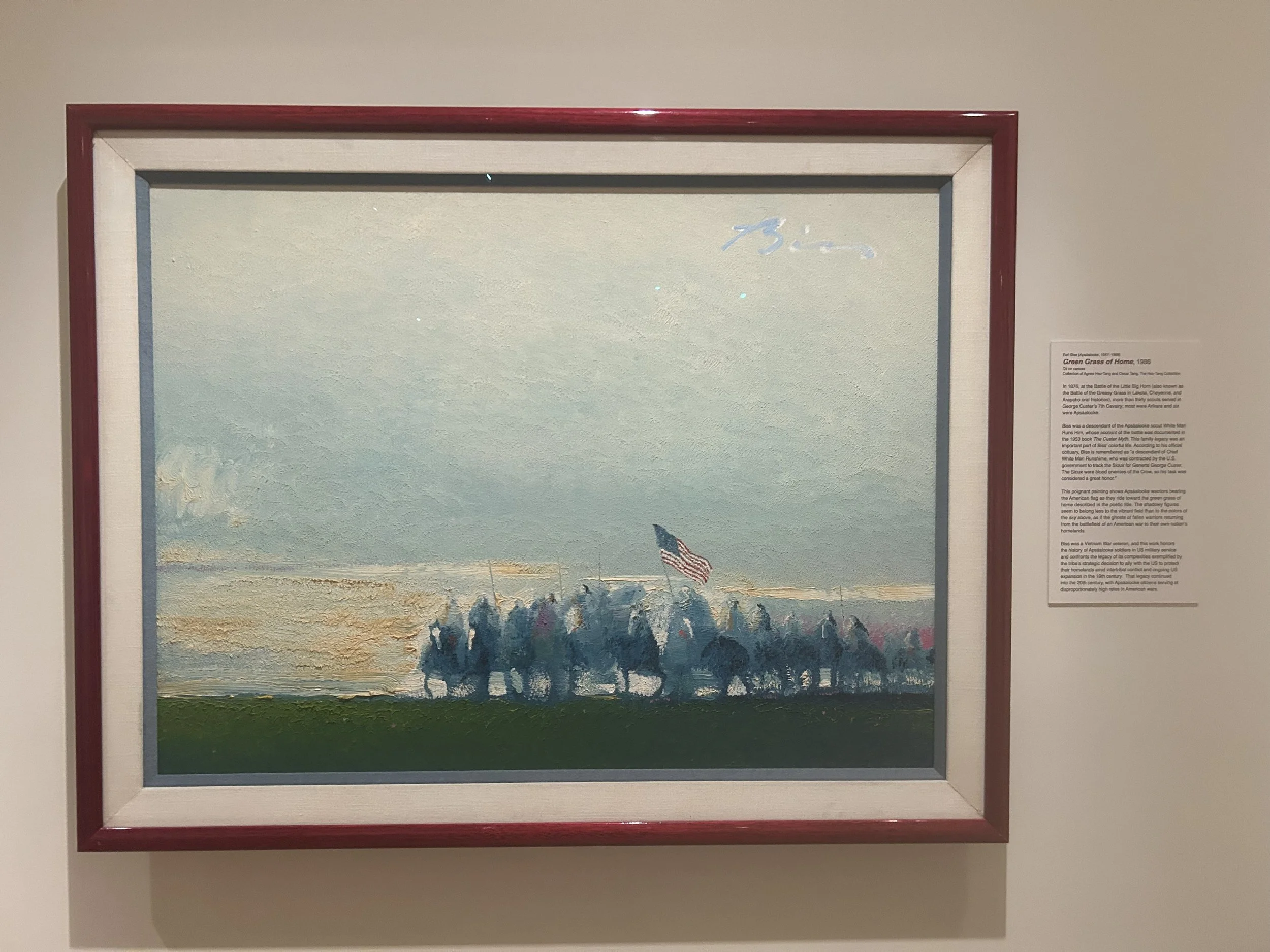
Green Grass of Home, painted by Earl Biss, a descendant of an Apsáalooke chief who was part of a group hired to perform tracking for General Custer.
Another powerful piece on display is No More Stolen Sisters by Del Curfman. Captured on such a large canvas, the painting defiantly stands out in the room. It depicts Corrin LaMere, a young Apsáalooke and Chippewa Cree woman, in a powerful stance with the red handprint of the Missing and Murdered Indigenous Women movement covering her mouth. The words “No More Stolen Sisters” lie behind her, calling out the violence Native women face and the systemic failures that continue to fail them. LaMere, who suffered a stroke in 2024 and has bravely persevered on a road to recovery, is the perfect model of the resilience and defiance of the movement.
As I examined the painting, similar emotions resurfaced that I felt after watching the 2017 film Wind River. One of my favorite films of that year, it tells the story of an FBI agent investigating the murder of a Native woman in Wyoming with the help of a local wildlife officer. It’s a great murder mystery thriller, but thematically it touches on the same issues Curfman acknowledges in her painting. The film’s final text cards leave viewers with statistics about the violence suffered by Native American women, data that is horrifying. The film was one of the first experiences I had connecting to the Native American experience. It’s powerful, but with lead roles filled by Jeremy Renner and Elizabeth Olsen, the perspective feels somewhat removed from the Native American community.
No More Stolen Sisters and the rest of the exhibit possessed a different aura than what I felt while watching that film. Cara Romero, a Chemehuevi photographer whose work has been displayed in museums across the country, was one of the panelists during the opening night program. She aptly described this aura as an “ethnographic telling of history.” What she means is that the art portrays Native American cultures from inside the culture itself. I’m sure we’ve all seen artwork or other media with Indigenous peoples and cultures as the subject, but do those pieces actually capture an authentic perspective, or just a “traditional” portrayal?
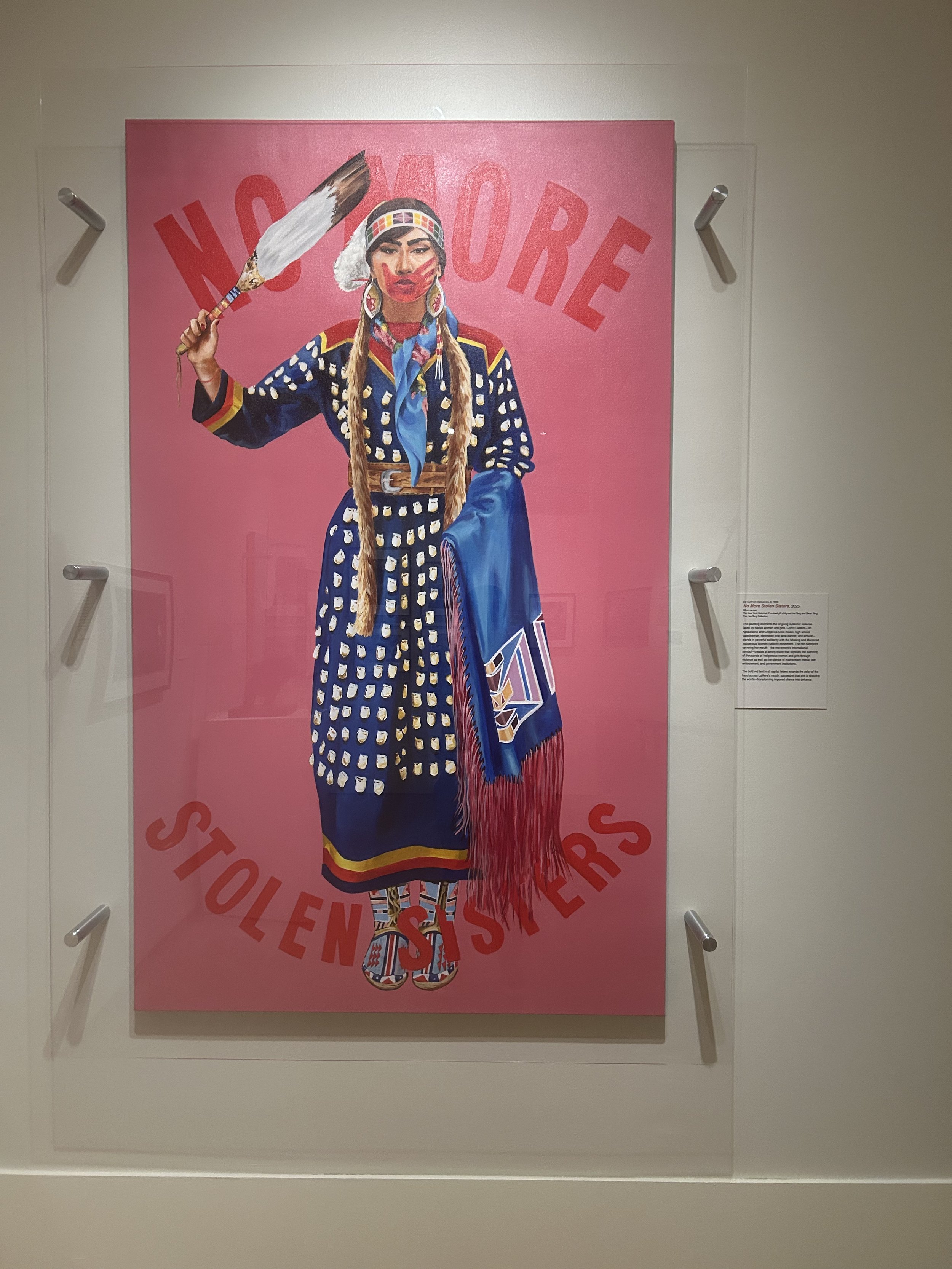
No More Stolen Sisters by Del Curfman
“House Made of Dawn” provides the opportunity to examine Indigenous art from an authentic Native American perspective. This collection is not only for art lovers but also for anyone interested in history. Beyond the canvas or the clay, there is a social and historical context in which these pieces exist, and it’s on full display.
It feels especially fitting that New York Historical is the place housing this collection. The original New York City museum was created in an effort to preserve the history of the era at the turn of the 19th century. As stated by the founders, “Without the aid of original records and authentic documents, history will be nothing more than a well-combined series of ingenious conjectures and amusing fables.” The housing of this collection is just another example of history being recorded and protected. As we celebrate 250 years of American history this year, House Made of Dawn ensures that American art history includes all who have called America home for 250 years, as well as those who called it home for much longer.
“House Made of Dawn: Art by Native Americans 1880 to Now” is currently open at New York Historical and will be on display until August 16. Book tickets through the museum’s website.