
Slainte to America at 250!
Does anyone else remember those school recess conversations where everyone asked, “What are you?”
That sounds like the opening line of a repressed bully confrontation. Let me rephrase.
After a social studies lesson on immigration, usually one that involved a few more vocal classmates offering up their ancestry as examples for the teacher, I remember learning all my friends’ ethnic backgrounds during the following recess. Does anyone else remember those conversations?
I can only speak from my own experience as a white kid from the Northeast, but those discussions always fascinated me, especially when someone’s answer differed from my own: a 50/50 split of Irish and Italian, if you were curious. Even as a kid, I loved history, and the histories of different peoples fascinated me in particular. My classmates and I might have all been living similar lives in our suburban town, but when I learned that someone could trace their ancestry to multiple countries, or even continents beyond Europe, I was enthralled.
Enthralled by the idea that everyone’s family history, no matter how distant or different, somehow led us all to the same place, living this same American experience. Call it fate or coincidence, it didn’t matter to me. I saw it as one big story with countless unexplored threads.
I don’t think I articulated it quite that way in third grade, but I definitely thought learning where someone’s family was from was… cool.
Whether or not you found the same things “cool,” curiosity about ancestry is a distinctly American phenomenon. It has long been a point of interest in the United States, well before the rise of DNA testing kits like 23andMe. Of course, not all paths to America were as pleasant as my own family’s. And questions of ancestry have often been weaponized throughout American history—from exclusionary immigration laws to more recent political fearmongering that scapegoats specific demographics to distract from larger systemic issues.
But when I look back on that schoolyard moment,my friend turning eagerly and asking, “And what are you?”, it feels like a more respectful version of the question. It wasn’t hateful or condescending. It came from an innocent (if admittedly naive) place of celebration and acknowledgment that this country is, at its core, one of immigrants.
The American experience—its history, its identity—is shaped by many different peoples. One prominent group that has been here since well before tea was dumped into Boston Harbor is my own: the Irish.
To be clear, not my ancestors directly. My grandmom and grandpop emigrated from Ireland in the late 1950s, so my family missed a few major moments in early American history. But broadly speaking, Irish Americans have played an integral role in the formation of the United States.
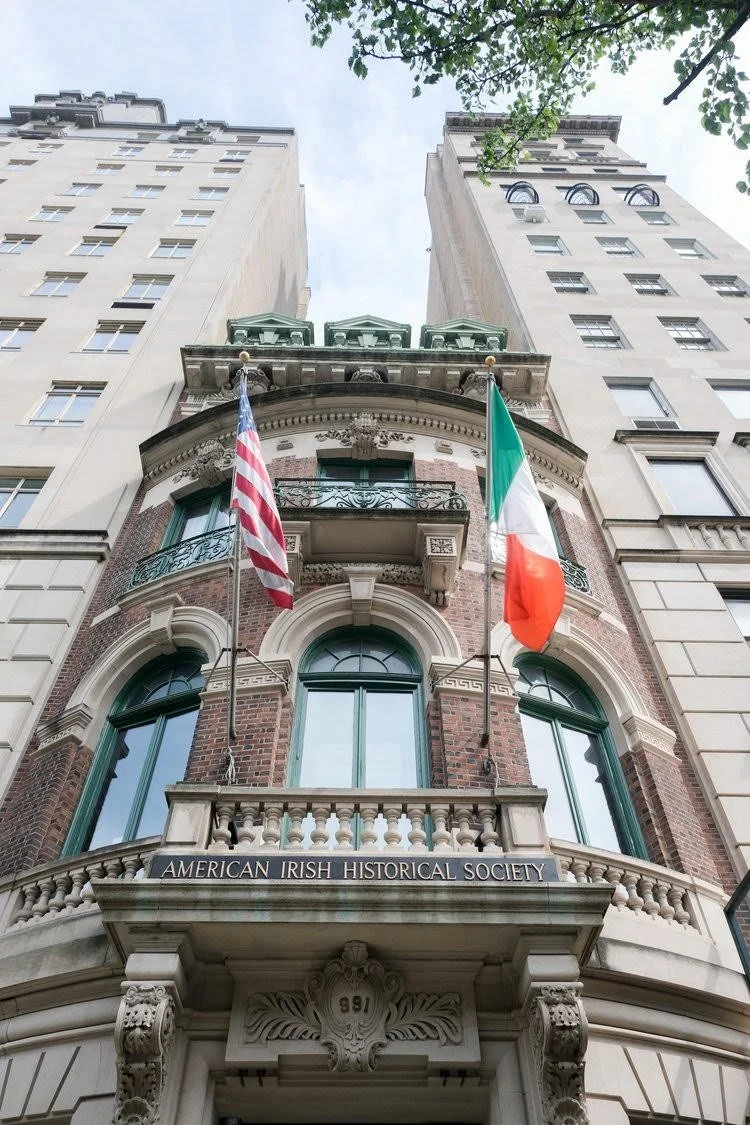
This year, during the semiquincentennial anniversary of the United States (that’s 250 years, for anyone else who—like me—didn’t take Latin in high school), the American Irish Historical Society (AIHS) is celebrating Irish contributions to American history. As part of a collaboration with Irish America 250, a nationwide initiative spanning multiple Irish American organizations, the AIHS is hosting monthly exhibits exploring different themes in Irish American history.
I attended the first exhibit, Revolutionary Heroes. While the exhibit itself is modest in size—two parlor rooms on one floor of the AIHS townhouse—the historical scope it covers is expansive. I met with Mark Lindenburg, the lead archivist at the American Irish Historical Society and the curator of the exhibit, who walked me through several of the pieces.
As the title suggests, the exhibit highlights Irish figures from the American Revolution, including Commodore John Barry, an Irish-born naval officer often called “the Father of the American Navy” (a title he shares, fairly, with John Paul Jones, a Scotsman). The exhibit also references the three Irish-born signers of the Declaration of Independence: James Smith and George Taylor of Pennsylvania, and Matthew Thornton of New Hampshire.
But the revolutionary theme extends beyond the American Revolution. The exhibit includes artifacts from the Irish War for Independence, such as an Irish tricolour flag captured during the Easter Rising of 1916, as well as a copy of the Bedell’s Bible from 1685—the first Bible translated from Latin into Gaelic. A cultural revolution, a political one, and a linguistic one, all held in the same space.
While the American Irish Historical Society building isn’t a museum in the same way as its neighbor across Fifth Avenue (a quaint, unassuming institution known as The Met), it houses an extensive archive of Irish American history. Founded in 1897, the society’s original mission was to correct widespread misunderstandings of the Irish experience in America.
I may be channeling a (white) grandfather’s rant, but the Irish were once subject to intense prejudice in the United States. That said, historical preservation today isn’t as closely tied to defending Irish identity—at least not in the same way. As a half-Irish white man, my ancestry has never been the target of discrimination.
Still, the title of AIHS’s year-long initiative, That the World May Know, feels apt. We may not need to “correct” Irish history, but there is immense value in fuller, more nuanced representation. Irish American history extends far beyond the Potato Famine and Manhattan’s abundance of Irish pubs.
As I walked through Revolutionary Heroes, the theme of rebellion began to feel larger than American identity alone. Americans are often characterized by revolutionary fervor, but that spirit wasn’t born here. The Irish had cultivated it for centuries under British rule and carried it with them into the American Revolution. America is a sum of its parts, and understanding where those parts come from helps clarify what the country is—and what it strives to be.
When I asked Mark what he was most excited to explore next, he pointed to Irish American stories from the 1960s through the 1990s. Beyond JFK, the Troubles in Northern Ireland, and U2, I’ll admit my knowledge is thin—but after seeing this first exhibit, I’m eager to learn more.
The Irish were here before the United States existed, and they’ve been here ever since. This year-long exhibition series aims to showcase that continuity, and I hope other cultural and historical organizations take the opportunity during America’s 250th anniversary to do the same. The world may be a hot mess, but 250 years of the American “experiment” is still worth marking—even if right now it feels more aspirational than real.
The American Irish Historical Society will host twelve exhibits this year in celebration of America’s 250th anniversary. The society also offers guided tours and access to an extensive research archive. More information is available at https://aihsny.org/.