
Books designed to defy convention. Pages that fold, fracture, and surprise. At MoMA, The Surrealist Book: Tomorrow Lives in Mirrors celebrates the strange possibilities of the printed page. There's just one problem: so much of that magic remains locked behind glass.
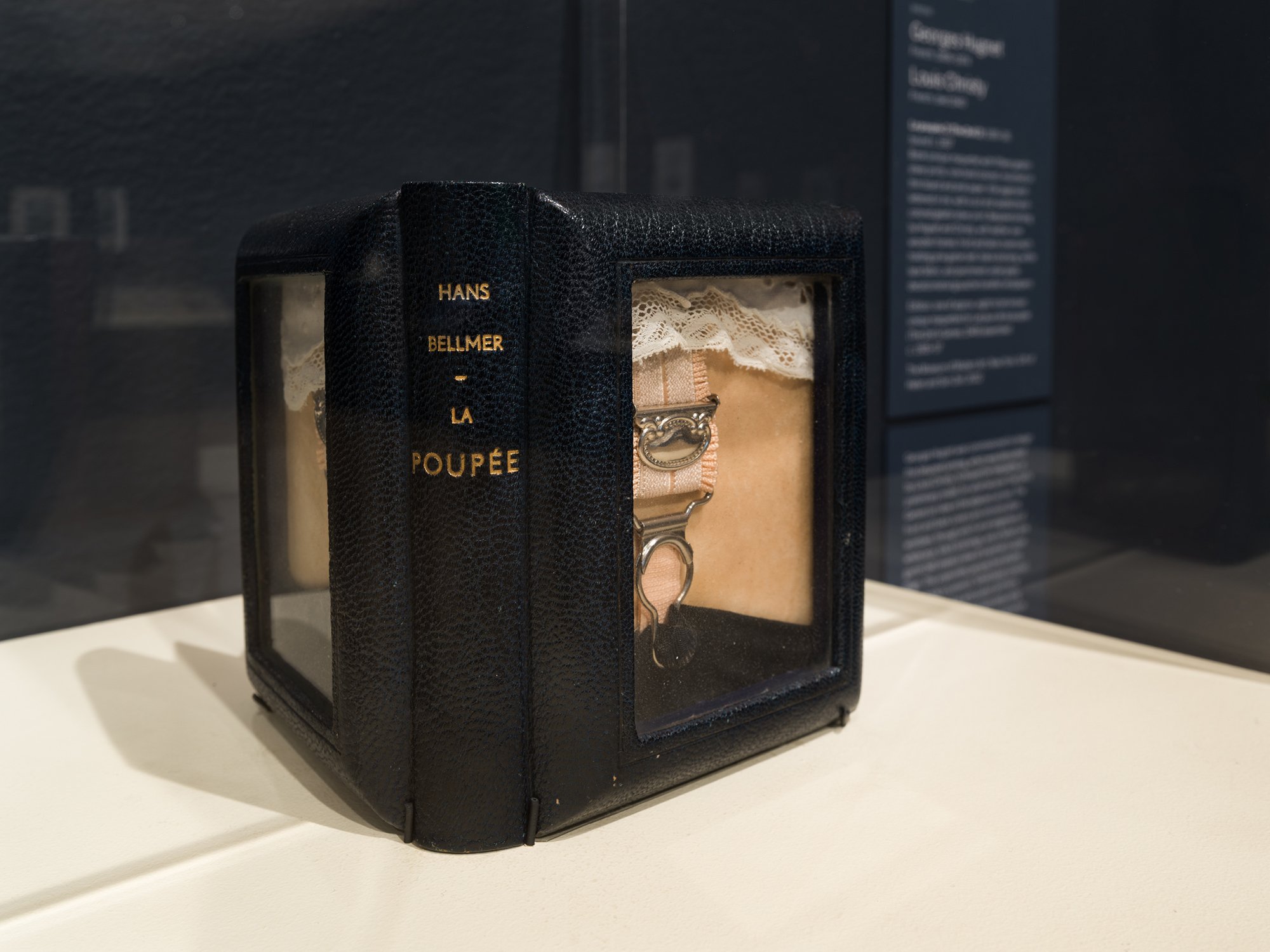
Installation view of The Surrealist Book: Tomorrow Lives in Mirrors on view at The Museum of Modern Art, New York, from October 4, 2026, through January 23, 2027. Photo by Jonathan Dorado © The Museum of Modern Art, New York
MoMA’s The Surrealist Book: Tomorrow Lives in Mirrors is full of some incredible objects, and even more incredible covers.
Unfortunately, that is also the problem.
These books are so cool and so weird. They are cut, folded, collaged, punctured, rearranged, shattered, and built to fight the normal rules of what a book is. The curatorial team even walked me through how complicated they are physically, with all kinds of materials and strange ways of opening. Some of the glass covers are shattered; one encases sand, another liquid mercury.
So, obviously, I do not want anyone manhandling a priceless Surrealist book. They are brilliantly designed and masterfully engineered by some of my favorite artists of all time.
Yet...you know that saying, you can’t judge a book by its cover?
This exhibition sometimes asks you to do exactly that.
Too often, you are left staring at a cover, in a case, with a label beside it. Sometimes there are open pages, but without an English translation, you are still stuck unless you read French or German.
Honestly, it bummed me out. So much of the art lives inside these books—in the text, the sequencing, the surprise of the next page, the collision of weird images and words. You are supposed to move through them, not just look at them.
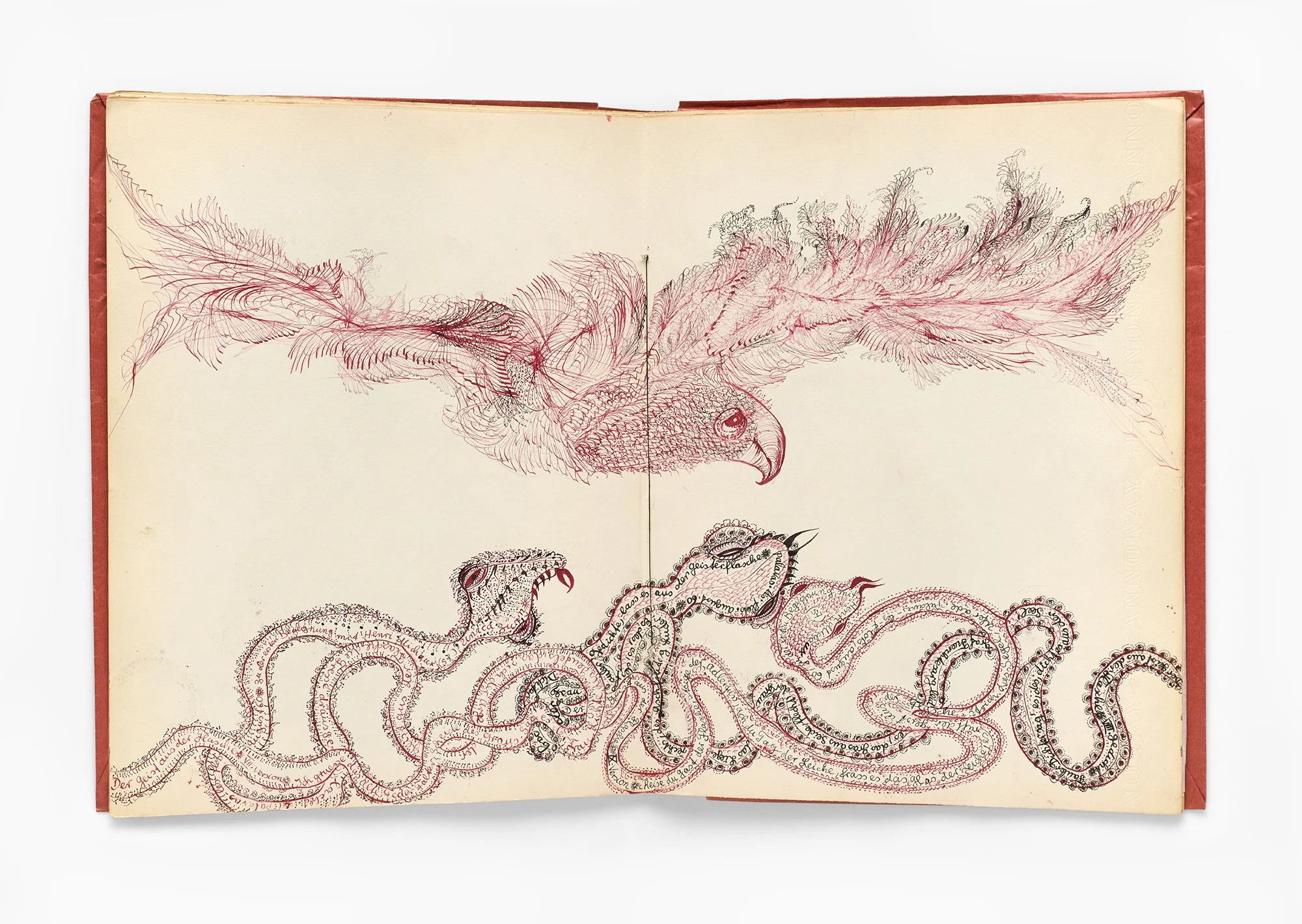
Courtesy: MoMA//Unica Zürn, artist and author. Orakel und Spektakel, IV. Buch: Anagramme und Zeichnungen (Oracle and Spectacle, Book IV: Anagrams and Drawings).
There are translations, mostly on the interactive screens, but not nearly enough for an exhibition in New York where many visitors will not read French or German.
So, I struggled with this presentation. Surrealism was built around breaking rules—the rules of logic, art, language, politics, even the rules of the supposedly “rational” society that had just marched Europe through one world war. These books were not simply beautiful objects. They were vehicles for those unruly ideas. They were meant to be opened, passed around, read, argued with.
And yet here they are, largely sealed behind glass, often closed, with limited translations available.
Which, sure, is a delightfully surreal way to present what is essentially a library.
Unfortunately, it also makes it considerably harder for a whole lot of these books to do something fairly fundamental to being a book: be read.
I kept thinking about the Brooklyn Museum’s newly opened manga exhibition. Again, an exhibition built around books made by brilliant artists and writers.
There, we got translations—both language and context. There were walls full of colorful, oversized graphics that let you actually see the details of the work. A literal library, with seating, where you could pick up manga and read it. Even a cute little manga frog directing you around the exhibition or popping out from behind displays, keeping that playful visual language going and making you, the visitor, feel like a character in his little journey through the museum.
They did not make manga behave like museum art. They made the museum behave a lot more like manga.
Why not do that here? It feels like such a natural option for MoMA.

Ray Johnson, artist and author. Th Thee for and Lai Book. c. 1955//Photo by Ben Blackwell
© 2026 Ray Johnson Estate / Artists Rights Society (ARS), New York
Give me a Surrealist reading room. Give me replicas I can touch and look through. Give me more translations. More open pages. Give me something that actually pulls me into these worlds—post–World War I Paris cafés, manifestos, exile, advertising, cartoons, counterculture. I am not asking for Disneyland. I am asking for atmosphere.
Give me a Cult of Sappho–inspired corner where visitors can try making their own little books. Give me something tactile, strange, participatory. Something that lets the ideas escape the glass.
Give me a full-wall evocation of the room where Toyen hid Jindřich Heisler during the Nazi occupation. Show me the claustrophobia. Then show me the tiny beach image from I Have Never Been There. Let me feel the stark contrast between that small, impossible escape and the world they were trying to survive. I want to know their fear of discovery as I read through this tiny refuge: a Surrealist book.
Instead, the galleries are mostly dark navy and white: very handsome, but quiet and safe. I kept imagining how memorable this could have been if each room pulled you into the moment that made these artists.
These are Surrealists. Why does the room feel so dim and conformist?
The moments that do open up are great. Ray Johnson’s work, with cartoons, advertisements, found images, newspaper scraps, and childlike language, suddenly feels playful and alive. For a second, the book stops feeling like a relic and starts feeling like an idea.
I wanted more of that.
MoMA has preserved these books beautifully. I just wish it had trusted us with more ways to experience them.
Because if these books are doorways, I want to walk through them.
The Surrealist Book: Tomorrow Lives in Mirrors is on view at MoMA through January 23, 2027. Go see it. Get frustrated. Get inspired. Read what you can, look closely, and leave wanting to make something strange of your own.
The time is right for a new Surrealist movement after all.