
Spending a Day at the Brooklyn Museum with Iris Van Herpen
What happens when couture, biology, engineering, and art collide?
At the Brooklyn Museum, Iris van Herpen's Sculpting the Senses transforms fossils, coral, living algae, and haute couture into one of the most breathtaking exhibitions you'll see all year.
Upon arriving at the Brooklyn Museum, you can already tell this is going to be a BRILLIANT exhibition. Everywhere are Van Herpen's signature organic shapes, bio-mechanical structures, and garments full of movement. I know the last time I wrote about the Brooklyn Museum, I was frustrated by an exhibition that felt more like a broad homage and moneymaker than a focused argument about why something matters (cough-it-didn't-cough*). But the museum's modern fashion exhibitions are often where it is strongest, and Sculpting the Senses proves that again.
I want to start this off by saying: Iris van Herpen is one of the leading experimental fashion designers on Earth today, so yes, this is going to be a bit of a fan letter. BUT! I would be remiss not to explain why her work is sooo monumental.
Van Herpen's work has not only influenced fashion, but has also been pulled into conversations around architecture, manufacturing, biology, choreography, sound, and materials science. She makes clothing a testing ground for ideas that usually live somewhere else: the flexibility of a printed structure, the intelligence of a fungal network, the rhythm of a moving body, the bio-intelligence of organic form, or the pressure of sound. Her work shows that engineering can move through couture without becoming a gimmick, making 3D structure feel wearable, intimate, and alive. And it's AMAZIIIIIIIING!
Thank you for letting me get that out of my system. Okay, so:
From the jump, the exhibition becomes a couture tour of our planet's ecosystems. Originally organized by Cloé Pitiot and Louise Curtis for the Musée des Arts Décoratifs in Paris, the Brooklyn Museum's presentation is masterfully, and quite frankly BRILLIANTLY, organized by Matthew Yokobosky, Senior Curator of Fashion and Material Culture, with Imani Williford, Curatorial Assistant. The natural history objects, sourced from beloved institutions including the American Museum of Natural History, the Staten Island Museum, and the Yale Peabody Museum, alongside works from the Brooklyn Museum's own collection, are some of the best curatorial choices I've seen in an exhibition in a long time. Genius moves deserve genius cred.
Upon starting our tour with Iris herself, I politely and barely contained my fan-girl scream. She began telling us how she grew up between two rivers in the Netherlands and how her current studio overlooks the IJ (pronounced "eye") River. She said water slows her down, and walking through the exhibition, that little biographical detail shows up everywhere, acting as a kind of underlying logic for her work. Water is, after all, the source of all life, and it seems all life is the source of Van Herpen's inspiration.
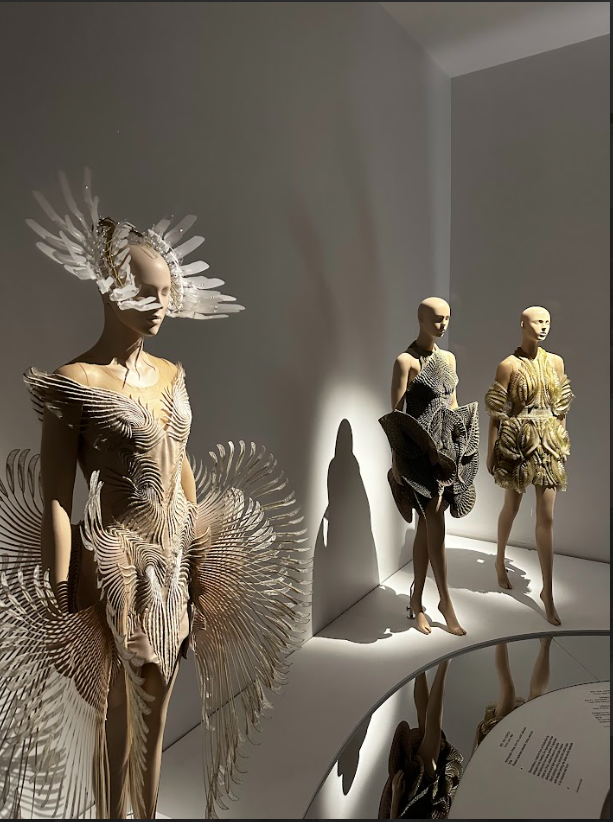
The pieces ripple, flare, hover, molt, and bloom. Some are isolated, rigid structures; others are all sinuous movement. Every inch feels like a biological study, an engineering schematic, or both! Skirts roll into the ridges of a snail shell. Bodices weave in and out like spider webs. Light flashes and dims as the body moves, or as we move around them.
Now, I LOVE to talk about the technology in Van Herpen's work, and honestly, you should too. The 3D printing, laser cutting, silicone molding, and material experimentation are part of why her work is so groundbreaking. But in person, her engineering is not cold or mechanical like a computer lab. It is a stepping-stone path through nature, bringing us closer to water, bones, webs, shells, algae, mushrooms, breath, and growth.
I mean this literally. Fossils, skeletons, coral, plants, and insects are placed next to garments, showing how a pleat becomes a branch. A bodice becomes an exoskeleton. Delicate lace structures suddenly look less like crochet and more like actual plant cells. After all, these natural objects were not originally formed to be beautiful, but as part of evolutionary survival. They are old, functional, morbid, and perfect. They are the roots of what we find appealing, and Van Herpen shows us both how and why they are so enchantingly breathtaking.
The paintings and sculptures around the garments should also be an argument for the curator's brilliance. Some are, quite literally, astronomical, engaging, and beautiful. Others are vivid, anatomical, and unsettling. They show all aspects of nature, not just the pretty things: bodies, decay, pressure, mutation, and the unsettling fact of being alive, both physically and, in some cases, mentally. The surrounding works never compete with the clothing. They provide context, sometimes wordless. Everywhere, you can see and feel where Van Herpen's ideas came from and where they are going, always coming back to her brilliance as a designer and artist.
The further we were guided through the exhibition, the more I kept thinking of the study Taking a Shine to It, which argues that humans are drawn to glossy surfaces, such as gems and polished metals, because the body still recognizes the shimmer of water as survival.
Van Herpen's work shows us exactly that. Beauty is not always some elevated cultural instinct meant to show how powerful, worldly, refined, or hot we are. Maybe, sometimes, it's our own bodies recognizing survival and simplifying the feeling as "pretty." After all, our minds are so overwhelmed with the machinery of modern life, schedules, lists, plans, goals, ugh, more lists, that it becomes almost impossible to recognize our base needs at their deepest biological level. We simply say, "It's cool," and wonder why we just got chills or why our eyes suddenly became wet.
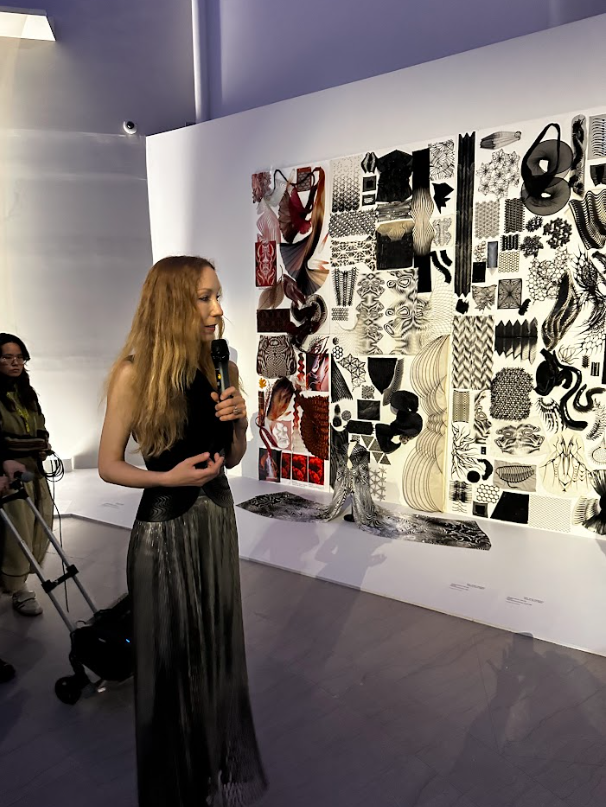
Wanting just a glimpse into her brilliant mind, I asked Van Herpen what material she hates working with. I expected her to say something non-textile, like metal or wood, but at her core she is, in fact, a ten-toes-down textile artist. Her answer was wool.
I, of course, was startled into a mildly embarrassing laugh. Wool is so ordinary compared with the materials around us: algae, silicone, glass, laser-cut paper, and 3D-printed compounds. But coming from someone who works specifically in fabrics, her answer made sense. She described disliking wool and similar materials that feel too restrictive or prevent the skin from breathing. Basically, they are uncomfortable and itchy to be a human in, so she doesn't like using them. What she wants is the opposite: materials that feel, and stay, alive, with the goal of remaining connected to nature's life cycle. Which brings me to one of her crowning achievements: Sympoiesis.
A dress made from actual living bioluminescent algae, Sympoiesis is crafted from the glowing algae Pyrocystis lunula, a marine organism that emits light when disturbed by movement. You may be familiar with it as the kind of algae that makes the ocean glow when disturbed, like waves crashing into a shore at night or the outline of thousands of fish swimming through what looks like a night sky. (It's cute. Look her up.)
On the body, that reaction is mesmerizing. As the model walked, the dress glowed in response to her movement, letting you see where motion started, at the joint, and how that energy traveled outward through the garment. It made movement visible: a small event moving through the body as the body moves through the air and as we move through the world. Kinetic and visual and BEAUTIFUL.
The algae were not simply glued onto a dress, either. They had to be grown, fed, protected, and kept on a natural day-and-night schedule. Van Herpen and biodesigner Chris Bellamy grew the Pyrocystis lunula in seawater baths, suspended them in a specialized nutrient gel, and molded them into a protective membrane. Humidity, temperature, and rhythm all had to be tuned to mimic their marine home so they could stay alive and light up. Which means Sympoiesis was not only constructed but brought to life.
That is why you MUST see Van Herpen's work. She does not just look at nature and make something pretty from it. She studies how nature behaves, even keeping microscopes in her workshop so she and her team can study materials on the microscopic level. Van Herpen gets underneath the surface of her work, into pattern, cell, fiber, vein, and structure, then pulls that imagery back out and onto the body.
The creation room might be the best room in the exhibition because it shows the actual, intricate, handcrafted labor behind how one dress is made, honoring all those in the world who pull thread and wind wire. Surrounded by samples, tests, plot layouts, research, draping, and stitching, the room makes the work visible. In the center, videos play in real time, showing human hands working on fabric that blooms out from plainly draped mannequins. It is one stitch, one cut, one adjustment, one failure, one fix, and one tiny decision at a time.
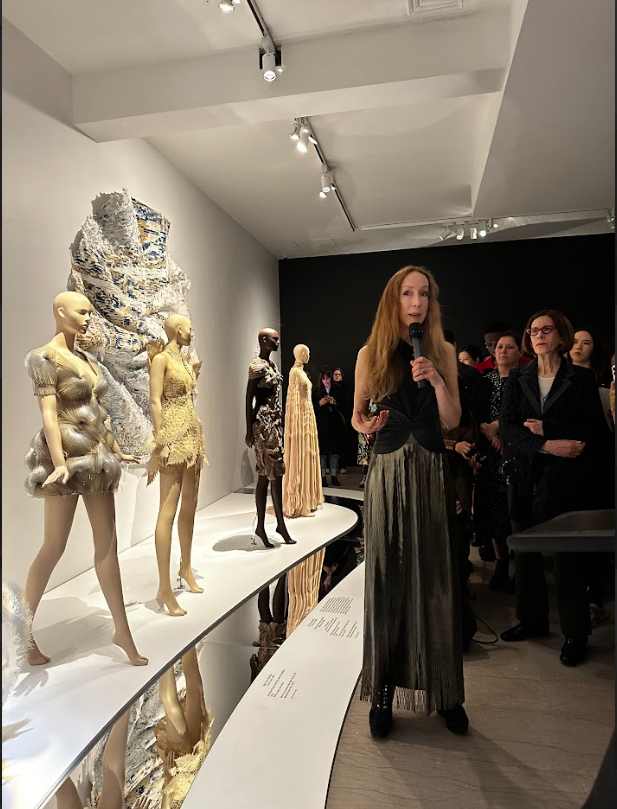
Look, I'm an avid hobby embroiderer, which is probably why this room felt like such magic to me. In a world where everyone wants everything to be perfectly beautiful, perfectly fast, perfectly unique, and perfectly made in no time at all, this room stops and shows you that is a lie. It reminds viewers that this fantasy is exactly that: a hope, not a reality, and anyone who says otherwise is selling you something. It lets you admire the time it takes to make such impossibly incredible things and honors the time and human hands that made them.
Iris van Herpen: Sculpting the Senses is on view at the Brooklyn Museum from May 16 through December 6, 2026. The exhibition marks its North American debut and brings together more than 140 haute couture creations alongside contemporary artworks, design objects, scientific artifacts, fossils, coral, skeletons, and natural history specimens.
I don't know where you are, but if you're in town, go see it immediately. Then see it again and again and again. Learn something about yourself, the world you live in, and how those two things do not have to be separate. It will just take a little more time, a little more effort, a little more patience, and a little more love. Just like the water she draws inspiration from, slow down and let her sculpt your senses.
Sources: Brooklyn Museum exhibition page and press release; Iris van Herpen's Sympoiesis / The Living Look materials; Vogue coverage of Sympoiesis and the Brooklyn Museum exhibition; Katrien Meert, Mario Pandelaere, and Vanessa M. Patrick's 2014 study, Taking a Shine to It: How the Preference for Glossy Stems from an Innate Need for Water; and my own silly little ramblings.