
The City We Inherited From the Dutch
America is turning 250 and behaving exactly like someone who just discovered milestone birthdays: loud, nostalgic, and determined to make it everyone else's problem. Lost in all the fanfare is another anniversary. New York City is turning 400. The New York Historical's Old Masters, New Amsterdam looks back to the Dutch colony that started it all, using 17th-century paintings to introduce visitors to the merchants, workers, drinkers, schemers, and ordinary people who inhabited the city before it was called New York.
Somehow summer is already on the horizon, and with the imminent change of the season, the country's 250th anniversary quickly approaches.
There have already been incredible celebrations across the city, and plenty more will continue to debut throughout the year, especially as we get closer to July 4, when cities across the country will host large events.
This year also marks another major anniversary for New York City that has not been receiving the same kind of recognition. Hidden behind the special-edition soda products, automobile marketing campaigns clogging streaming ads, and certain "news" brands feigning bolstered patriotism, 2026 is also the 400th anniversary of the founding of New Amsterdam, the original Dutch colony that would eventually become New York City.
Technically, there is some dispute over the exact year of the founding. The Dutch landed in 1624, but the settlement moved in 1625. Then came the official purchase of Manhattan from the Indigenous peoples in 1626, along with the formal planning of New Amsterdam's layout. So we're going to stick with 1626. It feels more official.
The New York Historical is celebrating this 400th anniversary with an exhibit titled Old Masters, New Amsterdam, showcasing pieces of 17th-century Dutch art. I had the chance to see the exhibit and attend the opening-night panel discussion with co-curators Russell Shorto and Arthur Wheelock, which completely changed my understanding of Dutch Golden Age art.
I started the night far from an expert, but I was very aware of the type of artwork that would be on display. Film school likes to touch on Rembrandt paintings in its early lessons on lighting. The masterful use of contrast and the groundbreaking ability to capture realistic lighting schemes, often from a single light source, are common characteristics of Baroque painting, and Dutch artist Rembrandt van Rijn is one of its most celebrated masters. Before we even touched a camera, we spent hours dissecting how light was depicted and determining the light sources within these images.
So, to sum this up, yes, I went into debt to learn lighting techniques from 400-year-old classical paintings. To add salt to the wound, it turns out I wasn't even reading the paintings correctly.
Sure, art is subjective. For me, the high contrast, harsh lighting, and embellished facial expressions found in many of these paintings often conjured feelings of tension and suspense. Those feelings, combined with my association of these lighting schemes with popular films, led me to assume that this art emerged from a period of social turmoil.
Wrong.
As Russell explained during the panel, the Dutch were actually in the middle of their Golden Age. Following the Eighty Years' War in the late 16th century, during which they successfully revolted against Spain, the rise of trade, a larger proportion of land ownership, and a broader sense of religious toleration than existed in many other European powers helped usher in a golden age for the Netherlands.
At the same time, the Dutch were searching for a national identity, and their art reflected that exploration. Aristocrats were not the only subjects of paintings. Artists depicted people from all walks of life. "Tronies," paintings that explored character studies, often through exaggerated facial expressions, became especially popular. There was an interest in the self, and the art sought to capture all types of selves and all expressions of the self.
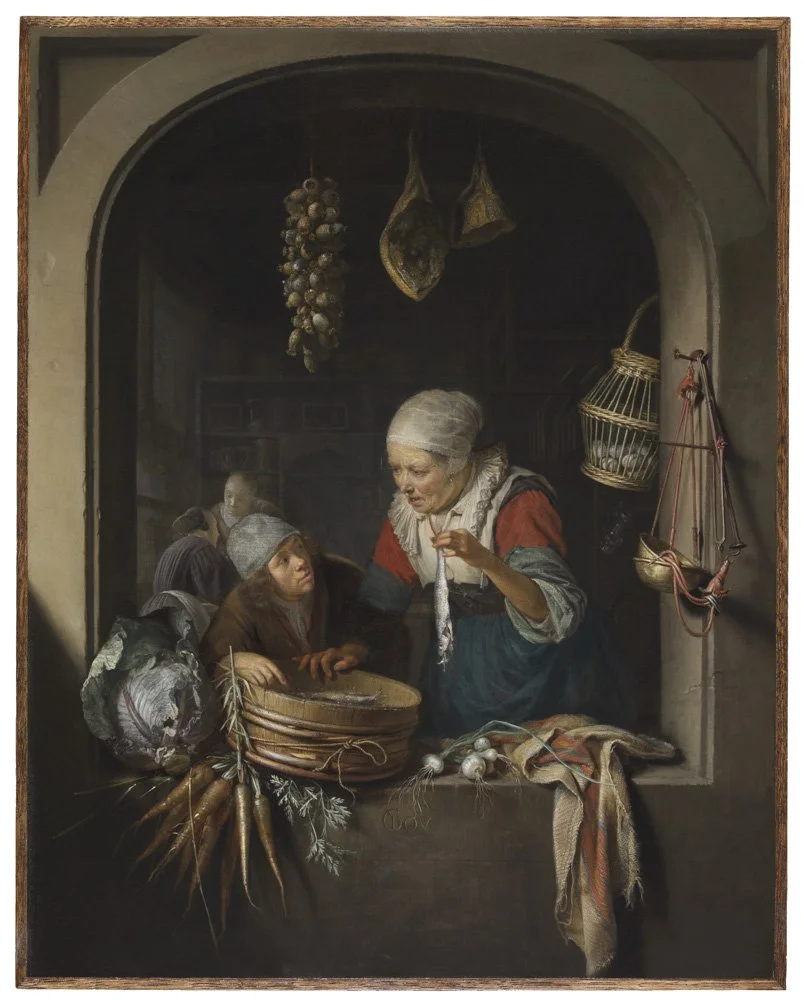
One painting on display, Herring Seller and Boy by Gerrit Dou (1664), shows an elderly woman and a boy standing in what appears to be the window of her shop. Before attending the exhibit, my eye would have been drawn to the deep shadows, drab garments, and textured facial lines. As someone accustomed to Hollywood films using soft lighting to beautify subjects, those features would have suggested a melancholy scene.
TITLE: Herring Seller and Boy
But the Dutch would not have seen it that way.
Dou may have used light and texture to create a more realistic depiction of his world, but people have always been people. Old women can deliver sass better than anyone, and who's to say that wasn't true 400 years ago? The way the seller holds the fish could even be part of a joke. Is she criticizing the day's catch? Is she trying to make a sale to a completely disinterested boy? Both are very plausible readings.
But with all this talk of the Dutch and their humor-filled paintings, why does this matter now?
Much of colonial America has the English to thank for its cultural roots. As English colonies, our language, certain traditional foods, and even our expectation of government representation were inherited from Britain. After all, we rebelled because of taxation without the representation that citizens in the homeland enjoyed.
Yet from the very beginning, we have been a melting pot of influences dating back 400 years to our Dutch predecessors. Without the Dutch philosophy of religious freedom, would New York City have become home to such a diverse population and a place that incubates new ideas from around the world? Without Dutch trade, would New York City have become a hub for global commerce? Would America have developed its capitalist fervor?
I'm not sure that last point is entirely positive, but the question still stands.
New York City is as much a product of its Dutch settlers as it is of its English colonizers, and Old Masters, New Amsterdam celebrates that legacy. Even though none of these artists ever set foot in America, the culture and people they captured on canvas certainly did.
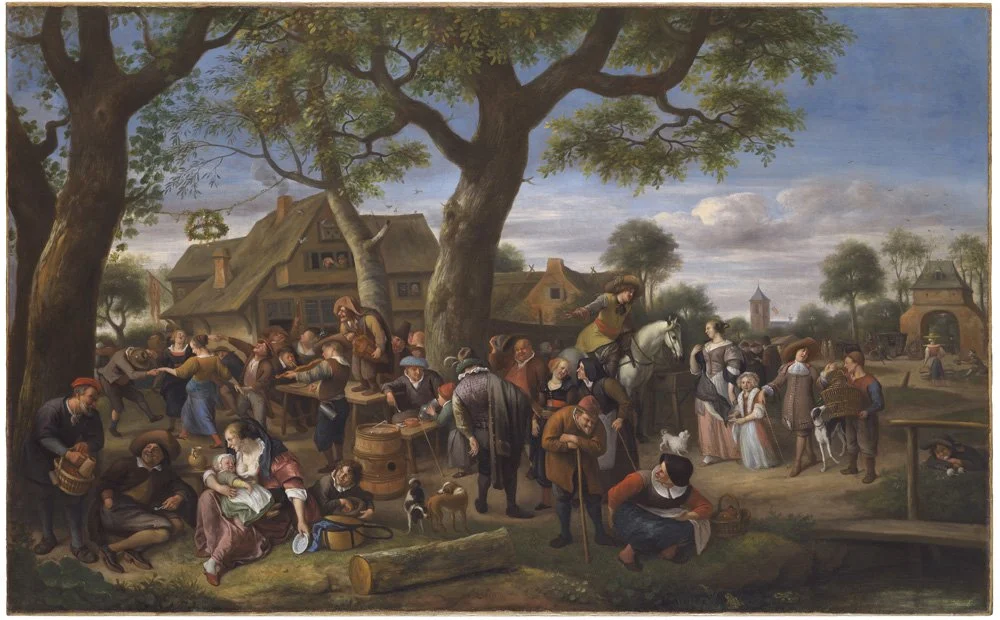
The exhibit's key image is Peasants Merrymaking Outside an Inn by Jan Steen (1676). The painting depicts a lively community gathered outside, well, an inn.
It perfectly encapsulates both the tone and the goal of the exhibit. For all the complaints the city receives from residents and outsiders alike, New York remains a place that fosters joyful community. The Dutch seem to have started that tradition, and over the last 400 years it has only spread.
At least I'm going to assume it was the Dutch, because it sure as hell wasn't the Puritans.
Old Masters, New Amsterdam will remain open through the end of August. Buy tickets through the New York Historical website.
Want to see another cool exhibit at the New York Historical Society?
TITLE: Peasants Merrymaking Outside an Inn