The Siblings Don’t Leave the Bedroom in Les Enfants Terribles
Two siblings. One bedroom. A private world of games, obsession, and destruction. Welcome to Les Enfants Terribles.
Before going to see this show, I did a small survey of the people around me: Had any of them heard of Les Enfants Terribles? As far as I’m concerned, it’s an incredibly famous and influential book and film.
Many of them had not heard of it; some had. If you’ve never heard of it, go check out the Criterion release and watch a wonderful film that influenced the French New Wave, which in turn influenced New Hollywood, and so on. Or check out the book, where Jean Cocteau’s incredible language transforms a strange but simple story into a poetic exploration of dependence and growing up.
But we’re not here to talk about film history. We’re here for Crawl Space’s adaptation of Les Enfants Terribles.
I wanted to preface this review by saying that this story comes with some artistic baggage for me. Fortunately, and unfortunately for them, I am French and very familiar with Les Enfants Terribles.
The story follows two siblings, Paul and Elizabeth, chaotic French middle-class kids growing up in the 1920s. Their toxic relationship with each other, and with the outside world in general, eventually leads them toward destruction. In summary, they are bored, privileged, sheltered kids who are a little too weird for their own good. They are the titular “terrible children.” As we would say, their feet are not exactly on the ground.
They were based on people Jean Cocteau knew personally, so for anyone who, like me, has known people like this, they will feel familiar.
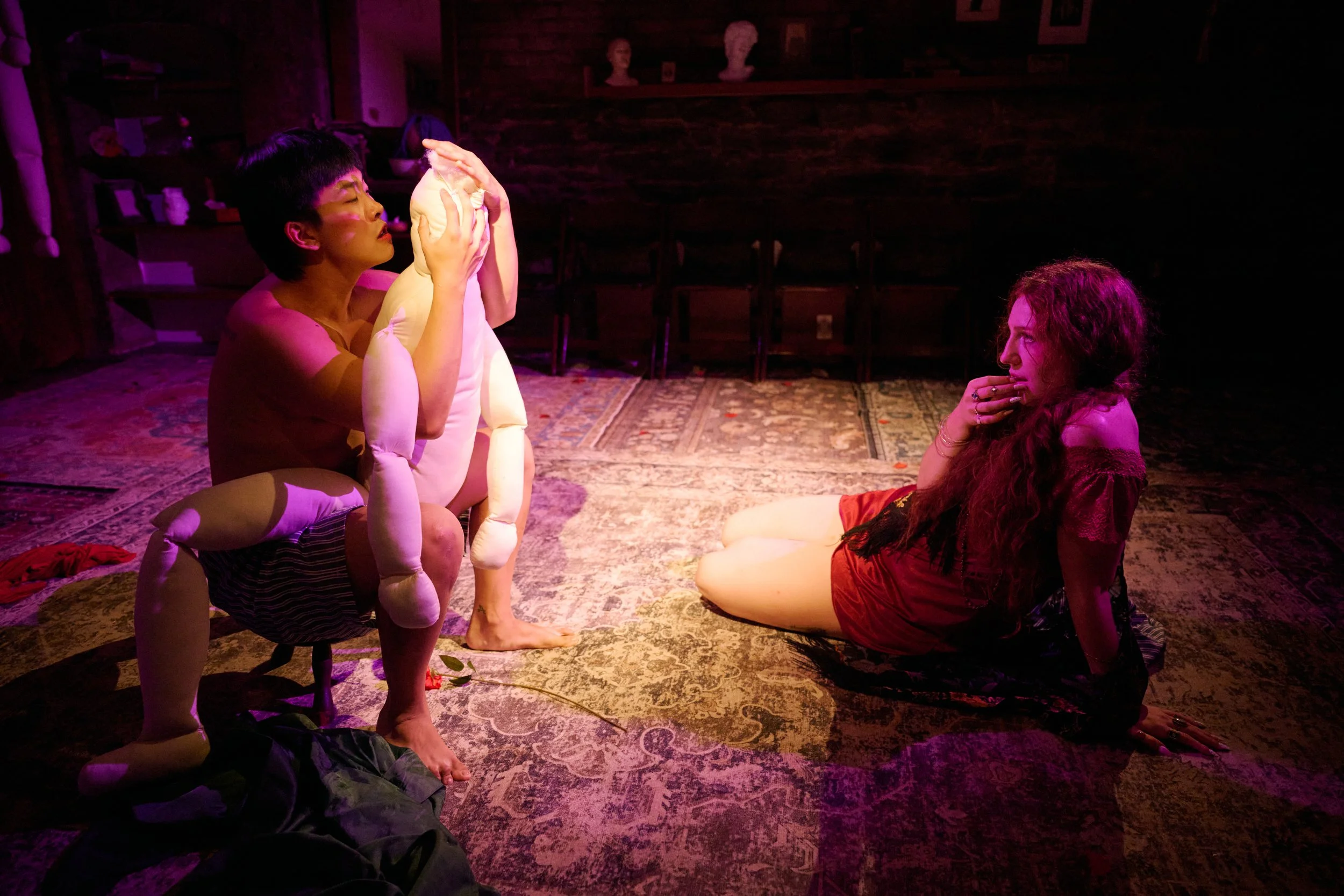
Credit: Kent Meister
Everything begins when Paul (Rutger Scott) gets hit in the chest with a snowball thrown by his crush and classmate, Dargelos, leaving him bedridden for a while. His sister Elizabeth (Maysie Jane) then has to take care of both him and their sick mother. From there, we get to know these two weirdos and their views, games, and obsessions.
What is immediately striking about this adaptation is the set. It is designed to look like a room in an apartment, with books everywhere, posters on the walls, and music playing. The audience sits along the walls while the action unfolds all around the space. Nowhere is safe.
And it starts immediately. Upon entering, I was greeted by the sight of Paul riding Elizabeth while their friend Gerard watched from the corner.
That was the pre-show.
Michael Gardner’s staging deserves praise because this show flows remarkably well in a very challenging space. There is very little room, and the way the characters interact with both the environment and the audience is fun and dynamic. Paul crosses the room to place a photo in the “treasure” while Elizabeth moves to the opposite side to pull a prop from what looks like a random pile of books. Characters leave the building and return from around the back. Overall, it’s very well executed and feels in the spirit of the original.
Another major point of praise is the cast. I have rarely seen a cast so committed. They are onstage for most of the show and have to deliver incredibly long diatribes while sitting on audience members, dancing, jumping everywhere, and fighting. It is an extremely demanding show with extremely demanding characters, and the cast is perfectly suited to their roles.
It is difficult to remain so committed and so completely “in it” when the audience is sitting inches away from you, but they manage it without faltering. They are a major reason to see this show.
Rutger Scott, who plays Paul, feels born to play a character who reeks of arrogance, charisma, charm, and insecurity all at once. He is quite perfect in the role. Maysie Jane does an amazing job as Elizabeth, who is, in my opinion, the most difficult character to pull off in Les Enfants Terribles. She has such complex emotional depth that, if played incorrectly, she could easily become a caricature. That was not the case here at all. Jane moves through Elizabeth’s emotional arc masterfully.
Victor Gao does a great job as the sweet, funny, and somewhat innocent Gerard, who simply follows the other two into their mischief because he wants to be included. Caroline DeFazio, as Agathe, rounds out the cast well, acting as a foil to Elizabeth and bringing a breath of fresh air to the second half of the play as the person who disrupts their status quo.
Now we arrive at my dilemma.
There are two ways I could go here, but I’ll try to be as clear as possible: Les Enfants Terribles is very difficult to pull off. This adaptation does a lot right, but it also does a lot wrong.
The choice to use only four actors and set the entire production in the siblings’ bedroom, with the characters using whatever props they can find to recreate scenes that originally happen elsewhere, could be a good one. The problem is that the production overcommits to having events described and reenacted by its two very unreliable and clearly unwell main characters. It creates a strange, untrustworthy, dreamlike state in which we don’t know what is real and what isn’t.
That becomes a problem for a story that is already quite odd.

Credit: Kent Meister
For example, in the original, Paul is obsessed with a classmate named Dargelos. It is heavily implied that Paul might be bisexual and have a crush on him, but regardless, Dargelos is the one who throws the snowball that injures Paul. When Paul gets home, we see that he has placed a picture of Dargelos inside the “treasure” he shares with his sister. That sequence establishes Paul, the treasure, the game the siblings play, and the strange world they inhabit.
In this production, we only hear about Dargelos and the snowball, although we do see Paul put the picture in the treasure. It doesn’t have the same impact because we have never seen Dargelos, so we don’t really know who he is. In the film, Dargelos is double-cast with Agathe, a later love interest of Paul’s, and I found myself wondering why that choice wasn’t made here as well. Having the actors play multiple characters could have helped the story flow better, even if it went somewhat against the “everything happens in the bedroom” concept.
Another example is the children’s mother. She is sick, and Elizabeth has to take care of her. Eventually, she dies, and the siblings inherit the apartment. All of this happens in the play, but again, we mostly hear about it. Everything begins to carry this aura of: Is it real? Are we in a dream? Are they making this up?
The original makes it clear that these events are actually happening and that these terrible children are evolving within those circumstances. This production could take more time and bring us along on that journey rather than forcing the journey upon us.
There are many examples of this commitment to an unstructured way of telling the story. There are few clearly defined scenes or settings. Characters reenact events rather than allowing the events themselves to occur, such as Elizabeth’s husband’s death or the trip to the beach, or simply tell us about them, as with Dargelos throwing the snowball or their mother dying.
Eventually, it makes the play feel confused and unfocused.
The language makes matters even more complicated, which brings us to Elephant in the Room No. 1 of 2.
Elephant No. 1 is Jean Cocteau.
If you don’t know him, look him up. He is one of the greatest French artists of all time, certainly one of my favorites, and, in my opinion, one of the greatest filmmakers and film writers in history. He wrote the original novel and was closely involved with the subsequent film adaptation.
Even that film adaptation had a problem to solve. Much of what makes the book work is its language. The way the story is told transforms these rich, privileged, sheltered brats into the subjects of a poetic journey—a borderline modern Greek tragedy. You follow them because you understand their thoughts, which are conveyed beautifully through Cocteau’s language.
That is difficult to recreate without the language itself.
But the characters don’t really speak that way. Sometimes they do, but for the most part, they express themselves eloquently but normally. So the film opted to use a narrator, Cocteau himself, to preserve the language it simply couldn’t do without, or else risk losing one of the major elements that made the book so powerful in the first place.
And it worked.
Here, there is no narrator, so the characters themselves use that language. Unfortunately, it makes the plot somewhat difficult to follow. We become drowned in a sea of dialogue—beautiful dialogue, to be sure, but we still drown in it. The point gets lost in very long diatribes, or the dialogue moves so quickly from one idea to another that there is no space for anything to breathe.
Because the dialogue doesn’t always correspond directly with what is happening, while much of the plot is reenacted, mimed, or described, you can probably see why it becomes confusing to determine what is real and what isn’t.
Put simply: these characters do not speak like that. Cocteau did.
Having the characters speak this way overcomplicates what they are trying to say, and we lose focus on the plot. It’s certainly a Catch-22, and one that, in my opinion, could have worked if the production had committed to one approach or the other. Reenact everything, but keep the characters speaking more “normally.” Or use a more Cocteau-like poetic language while giving us defined scenes, more characters, and a clearer outside world so we know what is real—and give those events enough time to land and affect us.
I can understand someone who has never seen or read Les Enfants Terribles assuming that this vagueness is inherent to the story. My plus-one did. But again, I am French and familiar with it, so I know it isn’t.
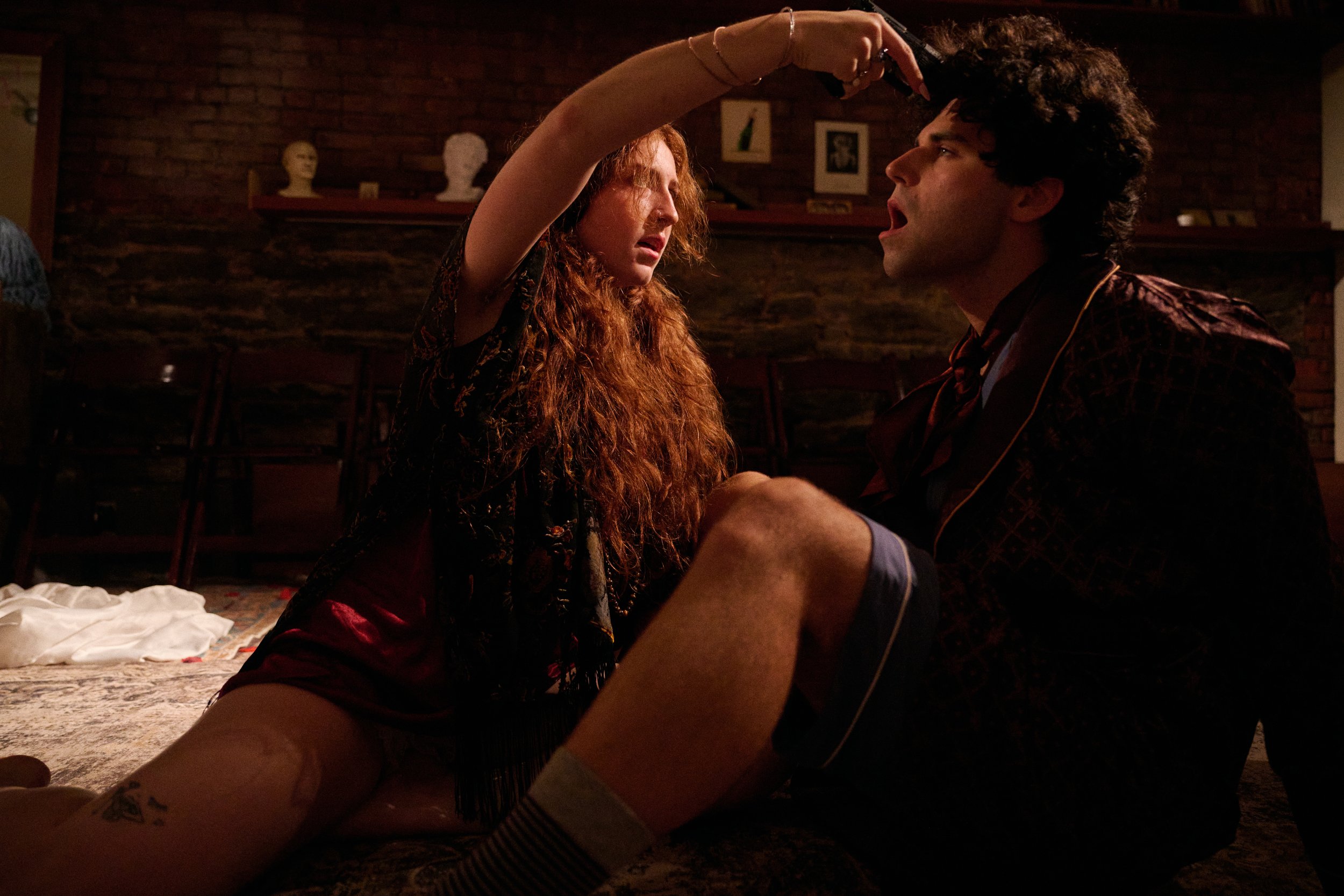
Credit: Kent Meister
Which brings me to Elephant No. 2: the sexual tension.
That is an extremely difficult elephant to tackle, but I’ll try.
Yes, in the original, the siblings have a toxic, codependent relationship. They are practically joined at the hip. They sleep in the same room, constantly fight and bicker, cannot stand being apart, and abhor the idea of another person arriving and taking the other away.
It is that jealousy that ultimately causes their destruction. Elizabeth lies to Paul and tells him that Agathe does not love him, and Paul—in a dramatic gesture, because that is who he is—poisons himself out of despair.
So yes, they are toxic.
Incestuous and sexual, though? Not really.
You can certainly interpret some of their interactions that way, and I wouldn’t fault anyone for doing so. But the emphasis in the book is less on sexuality and more on their toxic, consuming love for one another. There is very little to explicitly suggest a sexual relationship.
In this production, however, they are portrayed as much more sexual with each other, particularly during the pre-show. More than once, watching these siblings and the third friend they bring into their strange games—games that are violent, decadent, and borderline sexual in nature—I felt as though I were watching an adaptation of The Dreamers rather than Les Enfants Terribles.
In The Dreamers, a shy and quiet boy meets two siblings who bring him into their home and increasingly include him in their toxic, sexual, and strange relationship.
At its core, that is not what Les Enfants Terribles is.
This production loses some of the innocence of Paul and Elizabeth. They are 15. They are selfish, twisted souls who care primarily about their games and their treasure and become wildly emotional when they don’t get their way. All of that is present here, but at times, something is missing.
The innocence. The softness.
With those elephants out of the way, I cannot praise the actors and the production itself enough. What they accomplish, both in terms of acting and technical execution, in such a small space is genuinely impressive.
I want to recommend this production, but as a lover of Cocteau, I cannot tell you that it is the best version of this story you could see. It is more confusing and too fast-paced, and it is missing some of the softness that made the original feel like a strange, modern—at the time—Greek tragedy.
The production could benefit from another character who exists outside the bedroom, if only to establish that the outside world is real. If the intention was for us not to know what was real and what wasn’t, I’m not sure why.
It would also give Agathe—and DeFazio—more to do, because the poor woman spends a long time standing in the corner under a blanket before her character finally appears halfway through the show to reenact how she met Elizabeth.

Credit: Kent Meister
In conclusion, this is a fun, exciting, experimental, and impressive production of Les Enfants Terribles, with a brilliant cast and wonderful direction and production. But for me, it simply does not do justice to the original. It muddles the story and shifts the characters’ dynamic enough that my recommendation would come with a caveat:
If you see it, read the book afterward.
Then see what was lost in adaptation.