
This Anti-War Play Feels Way Too Familiar Right Now
What begins as something playful in Spider Rabbit slowly turns into a portrait of how the mind survives violence.
The energy lately has been bad, and I do not mean that in some vague way. People seem genuinely uneasy. About dictators. About wars we do not want any part in. About how quickly everything can start sounding insane while everyone is still expected to act normal. That is part of why surrealism does not feel like some dusty movement from the 1920s and 30s. It feels current. It came out of a world that had already broken, where reality stopped making sense and people had to find new ways to process it. Watching Spider Rabbit at La MaMa Experimental Theatre Club, I kept thinking this is what that looks like again.
I went in expecting downtown weirdness and got something much more unsettling. Michael McClure’s 1971 anti-war play, revived here by Tony Torn and Dan Safer, does not feel like a relic. It feels familiar in a way I did not expect. Not because it is easy to follow, but because it understands how violence gets absorbed. Not just shown, but normalized, softened, and made into something you can live with.
At first, Spider Rabbit feels like the host of a children’s show. He introduces himself, shows objects, repeats things, and keeps the rhythm light. It is silly until it is not. Then everything starts to turn. The objects get darker. The imagery gets physical. Blood, body parts, war, appetite, all handled with the same strange cheerfulness. It stops reading like nonsense and starts reading like a mind trying to survive something it cannot actually process.
I did not read Spider Rabbit as a child. He felt like an adult consciousness that has been pushed so far by violence that it has slipped into something childlike just to function. Someone who has seen too much, maybe done too much, and cannot come back from it. There is a kind of grotesque realism running through the piece that makes it feel like survival itself has been warped into something unrecognizable.
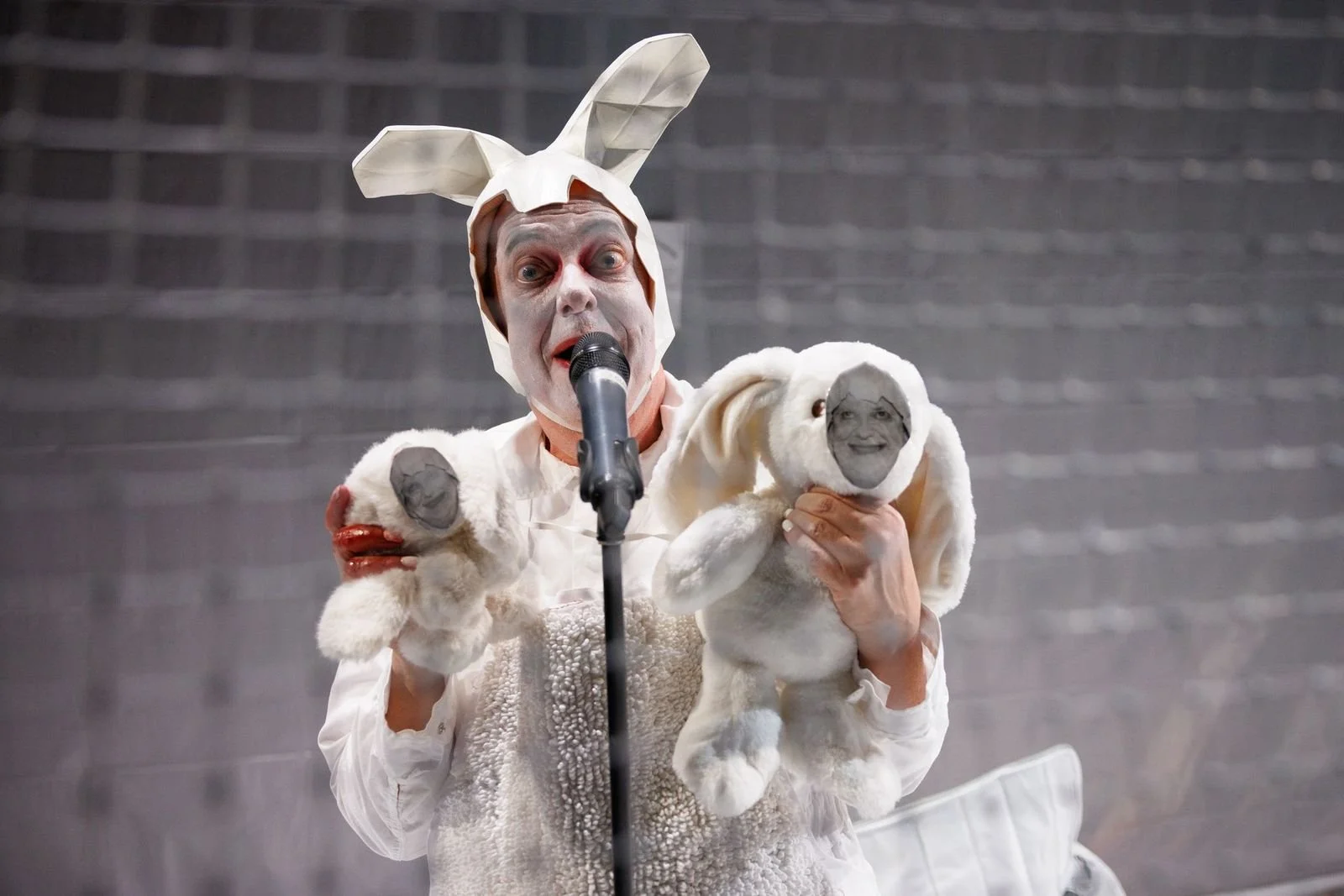
Tony Torn in Spider Rabbit. Courtesy: Everyman Agency PR
And raising my baby right now, I kept noticing things that made me uncomfortable. The way he fixates on objects. The emotional swings. The overbright performance. The way play and distress blur together when something is too much to process cleanly. It is not sentimental. It is structural. Watching him, I kept thinking this is what a mind looks like when it is trying to hold more than it can.
There is something almost Life of Pi about it, not in story but in logic. A psyche reshaping itself into something part animal, part child, part performance just to stay alive.
I also kept thinking about Gnarls Barkley’s “Crazy,” not literally, just that feeling. Being nowhere and nothing, out of control but also strangely relieved. The switches. The way everything runs on triggers instead of reason. Spider Rabbit does not feel theatrically insane. He feels blown open, like someone trying to keep going after reality has already collapsed.
That is why this lands now. America is again being asked to absorb war as normal, whether people want it or not. Spider Rabbit understands that war is not just something that happens elsewhere. It gets into the body, into language, into behavior, into how you relate to objects, to play, to yourself.
Spider Rabbit is not innocence under threat. He is what happens after innocence has already been broken and forced to keep performing anyway.