
From One House to Another
It’s not really about the objects. It’s about how someone chose to live.
I know it is a bit of a hike, but it is worth getting up to the East River to see Japan Society’s newest exhibition, Kawai Kanjirō: House to House. This is Kawai’s first solo museum show in the United States, and it quite literally brings his work from the house he built in Kyoto to Japan Society’s home for Japanese culture in New York City. Dedicated to a life of making, beauty, and change, the exhibition traces Kawai’s evolution from functional ceramics into sculpture, writing, and a broader philosophy of living. The exhibition itself follows that arc, from early utilitarian wares to late-career modernist wood sculpture.
House to House presents Kawai’s work the way it was likely meant to be encountered, not as isolated masterpieces but as natural parts of a home. His earliest ceramics were utilitarian pieces, the kind you could imagine living with every day rather than admiring from behind glass. Even as his work becomes more sculptural, poetic, and philosophical, it never loses its relationship to daily life. Kawai was never interested in separating beauty from use or art from practicality.
“I had many teachers.
They were ancient unsigned pots.
They were the many people turning
their wheels and applying glazes
at kilns in the countryside.
They were all my teachers.”
— Kawai Kanjirō
That spirit of humility and usefulness runs through the entire exhibition. I loved the serving bowl with hands inside it, which made the piece more beautiful while also clarifying what a serving bowl is meant to do: give. I kept returning to the blue ceramics, especially those made with the special blue glaze he developed. The blue did not read as pretty or delicate. It had force. Its deep turquoise, almost oceanic surface seemed lit from within. The peach-shaped vessels were beautifully made too, with glazes that gave them both richness and softness.
“Fire held in my hand
Fire hidden in clay
Fire concealing its form
A cold ball of fire
A ball of fire in my hand”
— Kawai Kanjirō
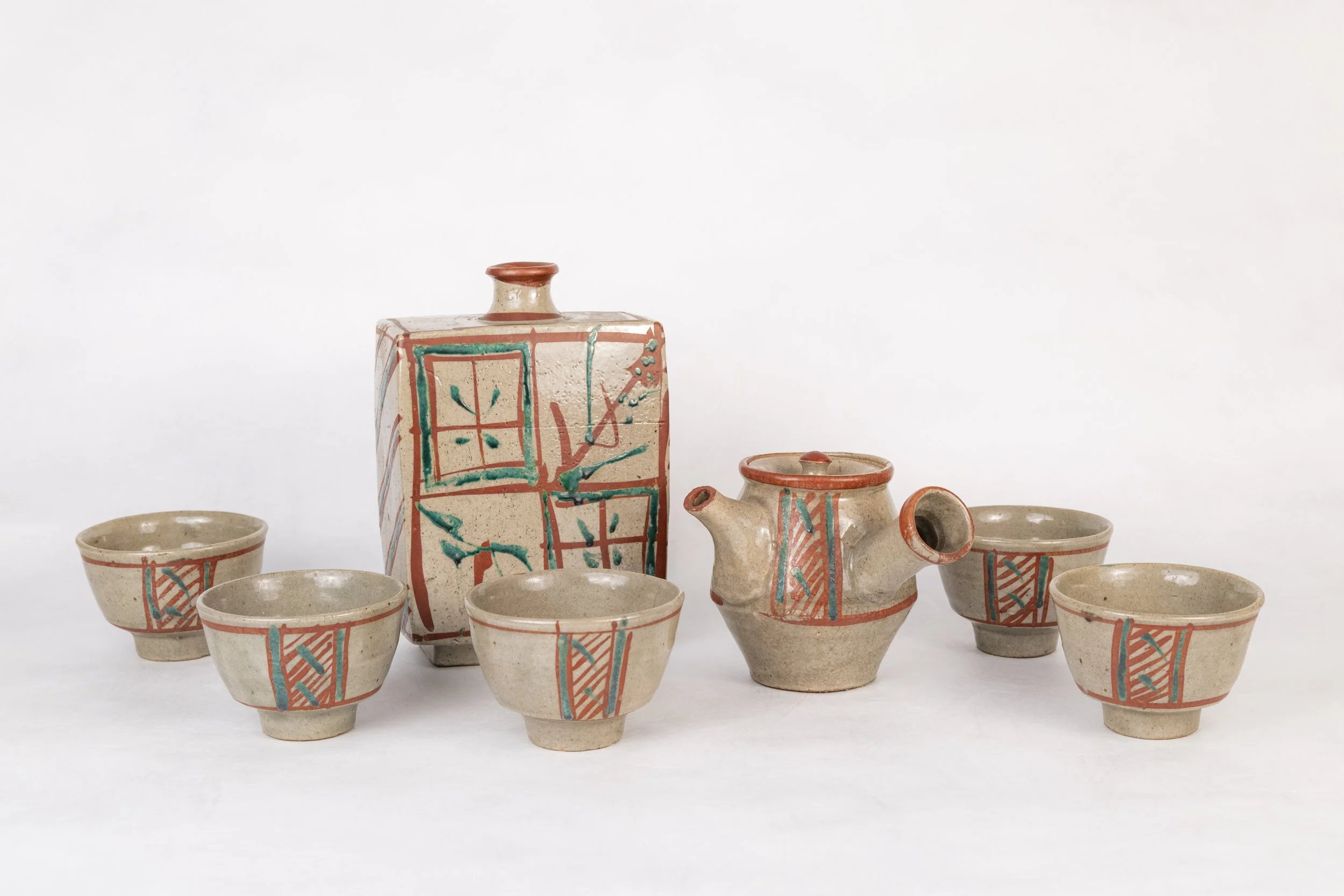
Hamada Shōji, Tea set. Japan Society Collection. Photo courtesy of Japan Society
Kawai’s ceramics may be the most immediate entry point into this NYC exhibition, but they are not the whole story. As the rooms unfold, so does a larger portrait of a person whose life and work kept pushing outward, from pottery into poetry, from utility into philosophy, and from vessels meant for the table into forms that feel more inward, private, and searching.
Kawai did not remain artistically or spiritually fixed. Born in 1890 and working through enormous cultural and historical upheaval, he moved gradually toward a broader philosophy of living, one shaped by his deepening spiritual life, his involvement in the Mingei movement, and his growing attention to what beauty might mean beyond ornament or mastery. Japan Society notes that he co-founded Mingei in the mid-1920s with Yanagi Sōetsu and Hamada Shōji, and that his work later moved from functional ceramics toward more individualistic sculpture.
“I have lived the past
The infinite past
I see the future
The infinite future”
— Kawai Kanjirō
That sense of time, personal, historical, and spiritual, gives the exhibition more scale than it first appears to have. What initially reads as a beautiful ceramics exhibition in New York opens into something larger, a portrait of a person thinking through how to live, how to make, and how to remain open to beauty through change.
In the wake of World War II, Kawai’s work became less bound to function and more open to inward, modernist, and sculptural forms. The shift feels philosophical as much as formal. His reflections on wartime destruction do not read as abstract or resigned. They suggest a person unwilling to treat devastation as inevitable and unwilling to let history harden into something distant and inert. Seen in that light, the late work feels not just experimental but searching, a way of thinking through rupture, survival, and what remains human after catastrophe. His postwar turn toward writing is also documented in the art-historical record, in part because wartime conditions limited ceramic firing and pushed him more deeply into essays and reflection.
“These words are not my words
These words are all the words of
those who read them”
— Kawai Kanjirō
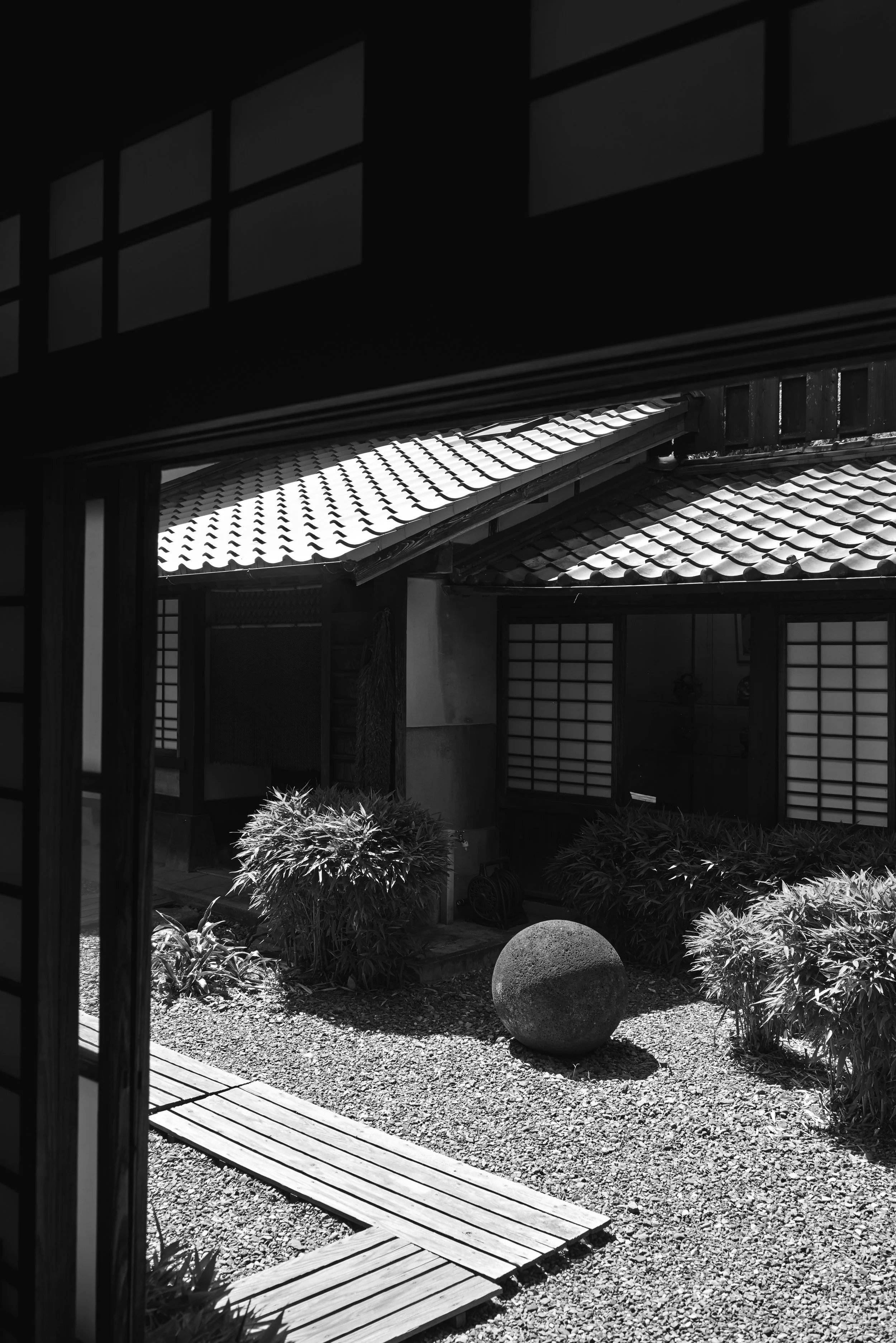
Garden view of the Kawai Kanjirō House. Photo courtesy of the Kawai Kanjirō House
That helps explain why the move into wood matters so much here. Starting around 1950, Kawai became deeply involved in wood carving, and the shift does not feel like a detour from ceramics so much as an expansion of the same concerns into another material. If the bowls and jars are about use, touch, and daily life, the carved wood pieces feel more direct, bodily, and inward. The wood masks, especially, are both whimsical and haunting, playful at first glance but edged with something stranger underneath. The bronze and brass pipes belong to that expansion as well. They are beautiful objects in their own right, dense and tactile, almost elemental in their weight and presence. Placed alongside clay, ink, and wood, they make clear that Kawai was using material itself as a way of thinking.
What made the evening especially memorable was that it never felt cold or dutiful. We were celebrating the movement of a life’s work from one house to another. The opening had real warmth, with excellent sake tastings by Dassai Blue, beautiful Japanese catering, and ikebana-inspired centerpieces. For a show so rooted in domestic life, ritual, and the beauty of handmade objects, that home-like atmosphere felt complete.
“Living is work.
Work is living.”
— Kawai Kanjirō
The family presence deepened that feeling even more. Kawai’s granddaughter and co-curator of the exhibition, Tamae Sagi, was there wearing her mother’s kimono. It made the evening feel like a family affair. For a retrospective centered on a figure whose home, philosophy, and practice were so intertwined, the opening was beautifully laid out.
That is part of what makes Kawai Kanjirō: House to House so successful. It does not simply present Kawai as a master to be admired from a distance. It lets him remain porous, usable, and alive. The work does not only ask us to look. It asks us to meet it halfway and, in doing so, reconsider how we live.
It was a beautiful event, and it is a beautiful exhibition. Everyone should go. Kawai Kanjirō: House to House is on view March 10 through May 10, 2026, at Japan Society, 333 East 47th Street, New York, NY.
“Even if I think I won’t be saved
I am saved.”
— Kawai Kanjirō