
Or a loft. Or a living room. Meet Present Company: the traveling theater troupe that brings professional, equity-level performances into New York homes and events, bringing dinner parties and mixers a delicious dose of drama.

Courtesy: Present Company & Luis Eduardo Suarez//A.J. Ditty and Amara James Aja embrace in front of the audience.
So, my lovelies with apartments who love entertaining: Have you considered putting on a play?
Not a little murder mystery over cocktails, your most dramatic friend reliving their latest adventure coughmecough, or even a writer friend having a couple of actor peeps read their latest script to the room. I'm talking about a full, professional union-approved theatrical production, complete with costumes, sound, lighting, shouting, stomping, and top-tier Broadway-quality acting.
I recently attended Present Company's production of John Patrick Shanley's Psychopathia Sexualis in a fabulous Brooklyn clocktower apartment, and somewhere between the emotional breakdowns, hilarious psychiatry, and my growing concern about noise complaints, I fell completely in love with the show, the cast, and the concept.
It was fantastic. It was intimate. It was wonderfully, ridiculously human.
And I couldn't help thinking: Why aren't more people doing this?
Present Company is a traveling theater troupe transforming private homes into performance spaces. You provide the room and the guest list. They bring the actors, the production, and a rather marvelous reason for everyone to put down their phones.
Think of it as the ultimate dinner-party trick: instead of waxing long about the wine's vintage, you get an entire professional theater company.
Naturally, I had questions.
I caught up with founder, actor, and co-director Tara Pacheco to talk about making theater out of New York real estate, why your sofa might be the next big thing in set design, and what happens when we bring a little more humanity into our homes.
A Conversation with Tara Pacheco
TNY: First things first. What possessed you to look at a New York apartment and think, "You know what this place needs? An entire theater company"?
Tara P: I have two big ideas behind Present Company. The first is that theater becomes something entirely different when actors and audiences are just a few feet apart.
The second is a rather clever experiment in producing theater without the overhead of a traditional venue.
Instead of renting a theater, mounting a run, and hoping people buy tickets, Present Company partners with hosts who already enjoy bringing people together. The host provides the space and the audience. The troupe brings a fully-rehearsed production. Every performance happens in a different home, giving the actors a new space to conquer and the audience a genuinely one-of-a-kind evening.
TNY: So you're telling me I can invite my friends over for cocktails and casually announce that an entire play is about to happen in my living room?
Tara P: Essentially, yes!
I envision Present Company becoming another option in the repertoire of people who love entertaining. Instead of planning another dinner, drinks, or the usual party, why not invite a theater company?
It's an especially appealing idea for the kind of host who enjoys curating an evening. Someone who wants to give their guests something to experience together rather than simply another excuse to mingle.
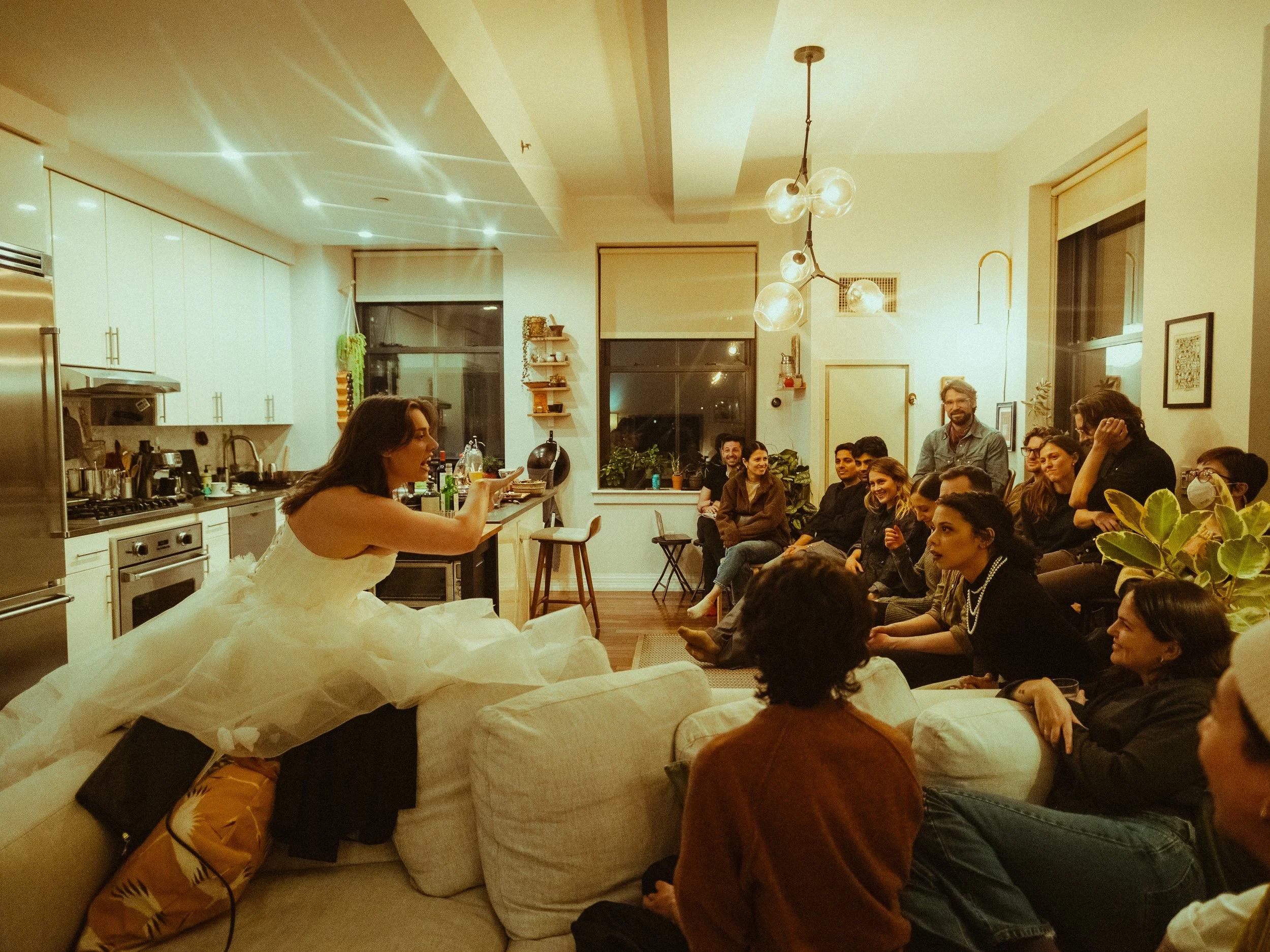
Courtesy: Present Company & Luis Eduardo Suarez//McLean Peterson on the left, Tara Pacheco on the right.
TNY: Frankly, I think it's a fantastic idea. Now, I have to ask about the logistics. This was a FULL performance. Jumping, stomping, shouting. I was genuinely worried about the downstairs neighbors. How do you make a play work in someone's actual home?
Tara P: This is where things get particularly interesting.
The company arrives with a rehearsed production, but the staging has to be adapted for every home. The actors are constantly negotiating new layouts, entrances, furniture, and unexpected architectural features.
Consider the psychiatrist in Psychopathia Sexualis. A scene might call for a couch, but what happens when the apartment doesn't have one in the right place?
Well, the actor gets creative.
These little challenges can inspire unexpectedly clever solutions. The story stays the same, but the way it unfolds can change dramatically from one living room to another.
I love the idea that an apartment might accidentally become a collaborator in the production. Your hallway could be a dramatic entrance. Your sofa could become an essential prop. That weird little corner you've never known what to do with might finally find its calling.
TNY: What I appreciated was that this didn't feel like a scaled-down production. The actors were fantastic. Was maintaining that professional standard important to you?
Tara P: Very much so.
I was deliberate about building Present Company around professional performers and working with Actors' Equity. I want the freedom to experiment with an unconventional venue without compromising the quality of the production or the treatment of the artists.
That means navigating professional standards, performer safety, fair compensation, and the particular complications of working in somebody's home.
It's a new model, but not an excuse to cut corners.

Courtesy: Present Company & Luis Eduardo Suarez//McLean Peterson on the left, Tara Pacheco on the right.
TNY: Having seen the results, I'd say that commitment shows. Speaking of the actors, why Psychopathia Sexualis? I mean, beyond the spectacularly scandalous title.
Tara P: John Patrick Shanley, the writer behind Doubt and Moonstruck, has given us a comedy about friendship, marriage, insecurity, and a therapist whose methods are, shall we say, questionable.
It's funny, occasionally absurd, and surprisingly tender.
The play was an especially good fit for the company's first production because so much of the story happens in intimate, domestic spaces. These are people arguing, confessing, interfering in one another's relationships, and generally behaving like people who desperately need therapy but perhaps not from this particular therapist.
In a traditional theater, you're watching those relationships from a distance.
Here, you're practically in the argument.
TNY: There were moments when I felt less like an audience member and more like a friend who had accidentally arrived at precisely the wrong time. Which, honestly, made everything funnier.
Now, let's talk real estate. Do I need a Manhattan penthouse, a dramatic staircase, and seating for 40? Or can those of us with slightly more modest apartments get involved?
Tara P: Fortunately, a spectacular penthouse is not a requirement.
Present Company is designed to adapt to different spaces. The company evaluates each location beforehand, works out the audience arrangement, and determines how the performers can safely use the room.
According to its hosting information, most homes can accommodate roughly 15 to 30 guests, and the actors need a separate private room to prepare.
And if you're not particularly interested in rearranging your apartment, the troupe handles the theatrical setup and returns the space to its original condition afterward.
The possibilities extend well beyond apartments, too.
Townhouses, galleries, offices, private clubs, and shared residential spaces can all become venues.

Courtesy: Present Company & Luis Eduardo Suarez//A.J. Ditty with the audience
TNY: Which brings me to my next question: Why stop at dinner parties? I'm imagining birthdays, anniversaries, holiday parties, gallery openings. Who should be calling you?
Tara P: I hope to reach people who genuinely enjoy bringing others together.
That's the beauty of the model. The performance can be the entire occasion or the centerpiece of a larger gathering.
Imagine hosting a cocktail party where the entertainment isn't background music or a magician hovering awkwardly near the bar, but a professional theater company performing a full play for your guests.
Or a residential building transforming its common room into a private theater for the evening.
For hosts looking to do something genuinely different, it's a marvelous option.
And for anyone wondering about the price, performances currently range from $2,500 to $5,000 or more, depending on the event.
Gather 25 friends to share the minimum hosting fee, and you're looking at approximately $100 per person.
For a private production where every seat is essentially front row? Not bad, New York. Not bad at all.
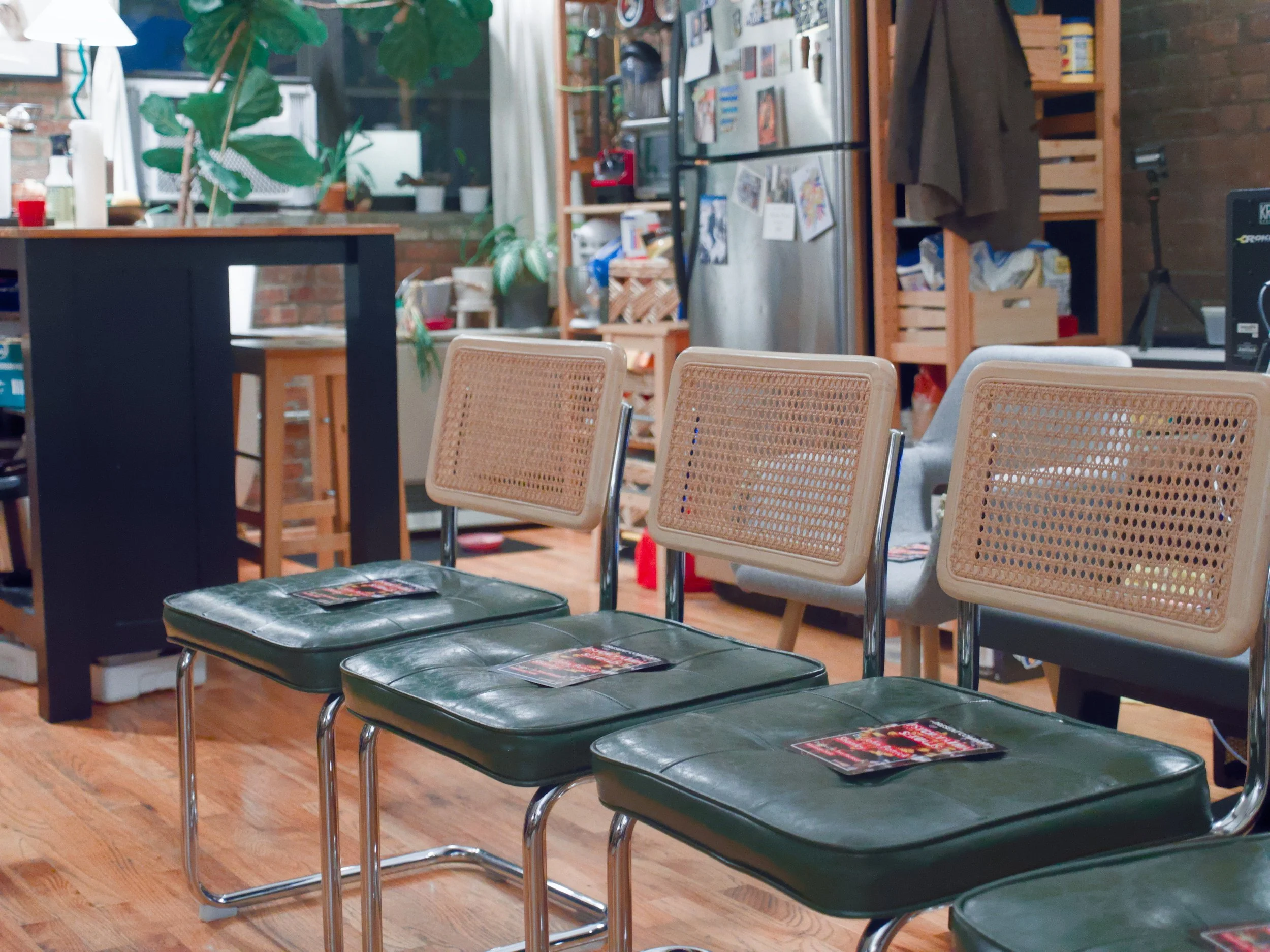
Courtesy: Present Company
TNY: One of the things I loved most was how human the whole experience felt. Someone laughs at something you didn't find funny, someone else gasps, and suddenly you're noticing everyone around you. Is that connection part of what you're hoping to create?
Tara P: This is the part of our conversation that stayed with me.
I see Present Company as a way of bringing people together, not simply moving theater into a smaller venue.
There's something about watching a live performance in close quarters that makes it impossible to forget you're sharing the experience with other people.
You're aware of the actors, certainly, but also of your fellow audience members. Their laughter, their reactions, their surprise.
And in a time when so much of our entertainment happens alone, on screens, or in carefully curated little bubbles, there's something refreshing about an experience that demands we simply be present.
No scrolling. No pausing. No deciding you'll finish the episode tomorrow.
Just people, in a room, being people.
TNY: Last question. Is this the beginning of something bigger? Because I'm already imagining a whole menu of plays people could choose from.
Tara P: That's certainly the ambition.
I hope to develop a larger company with multiple productions available for different hosts and occasions.
I'm already exploring new material and collaborations, with the eventual possibility of a rotating repertoire that can travel from home to home.
The goal is for Present Company to become something people think of when planning an occasion, with a selection of theatrical experiences to choose from.
So, Who's Hosting?
After speaking with Pacheco, I really hope she succeeds. I couldn't stop imagining all the places where Present Company could pop up next.
A gorgeous Brooklyn brownstone. A Manhattan loft. An art gallery after hours. A private club. That friend with the enormous apartment who is forever looking for an excuse to throw a party.
And why not?
There's something gloriously extravagant about hiring an entire theater company for an evening, but what I found most appealing wasn't the exclusivity or even the novelty.
It was the togetherness.
We all live on top of one another in this town, and I don’t know about you, but I can go days without really connecting with the people around me. We ride the same trains, walk the same sidewalks, and occasionally exchange a polite nod with someone we've lived beside for five years.
Present Company is doing something rather fantastic with that contradiction.
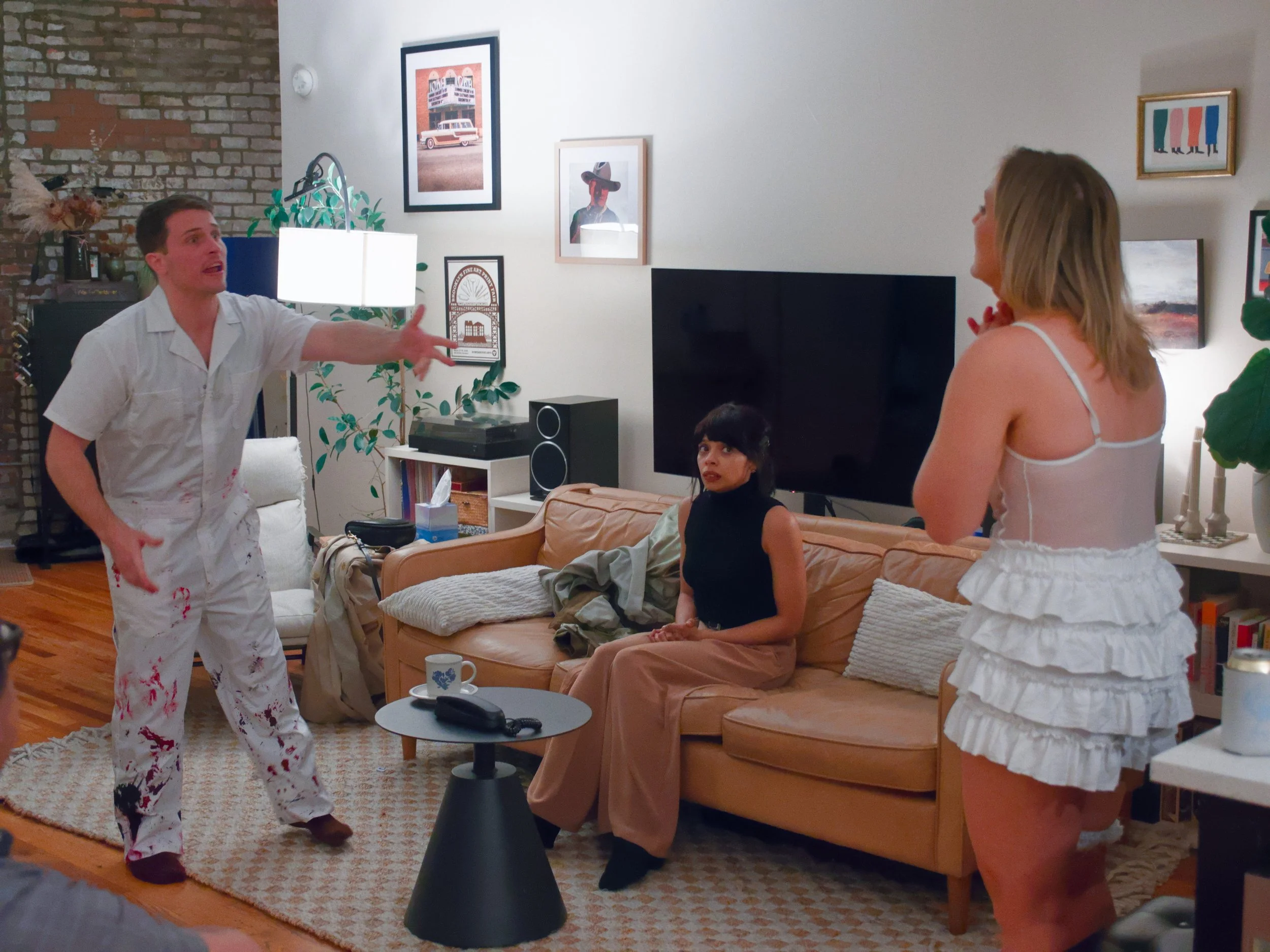
Courtesy: Present Company
They're taking theater out of THE theater and putting it back where people live. They're giving us a reason to gather, laugh, react, and be human with the person sitting beside us. To have an enjoyable human experience and build a memory with our community.
For 85 minutes, we were all in that living room together, watching a handful of deeply flawed fictional people try to figure out how to love one another in the most hilarious way, and it was the most wholesome experience I’ve had with strangers in a very long time.
So, if you're planning a birthday, a holiday party, a corporate gathering, or simply have a living room that's been looking a little too quiet lately, I highly recommend giving Present Company a call.
Just warn the neighbors. And please, invite me.
Present Company's inaugural production, John Patrick Shanley's Psychopathia Sexualis, is accepting private bookings across New York City through November 22, 2026. For information on hosting, visit presentcompanynyc.com.
Interview responses have been condensed and paraphrased for clarity.