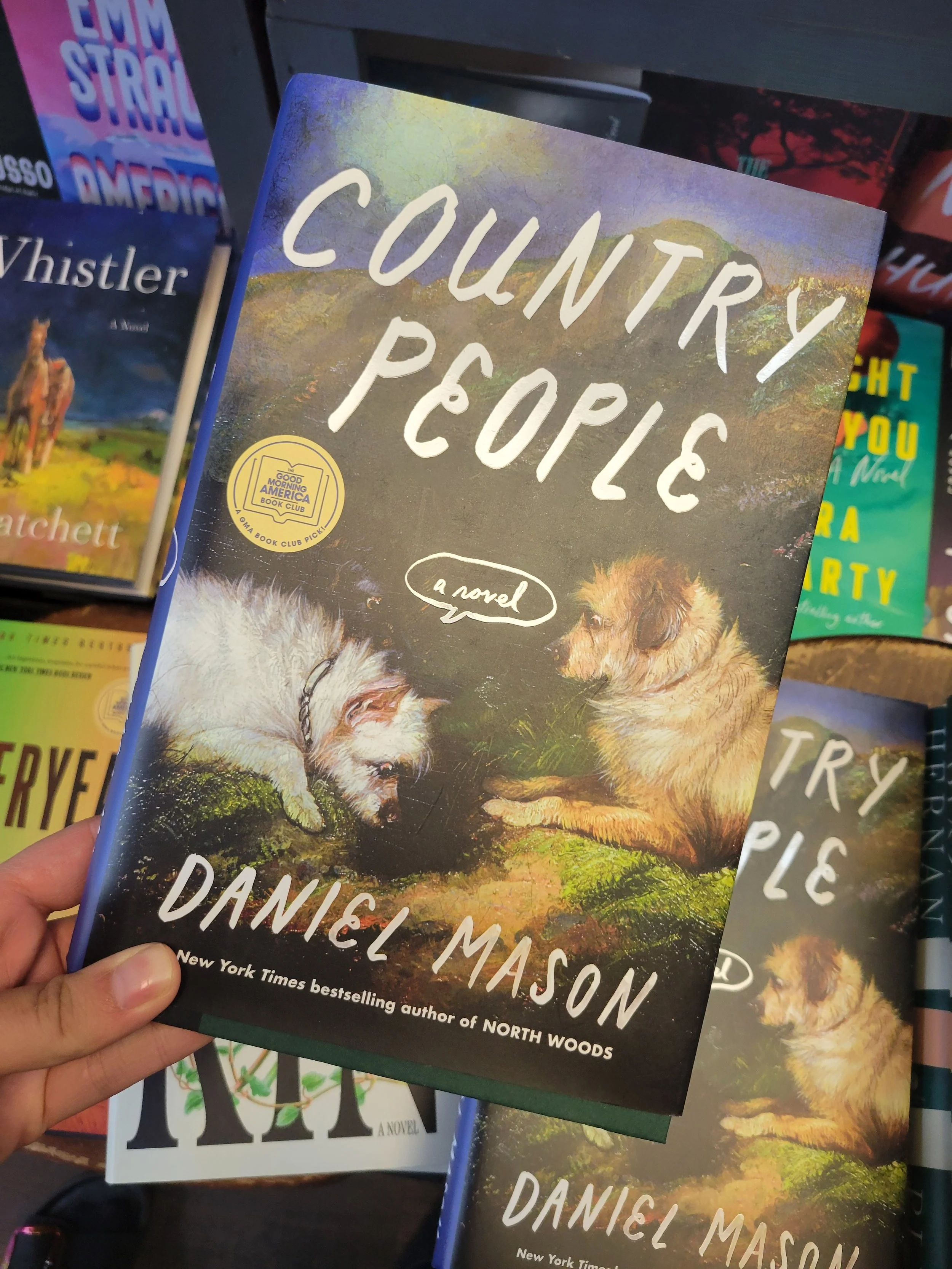
Miles Away from Charming: A Review of country People
I went into Daniel Mason's On Country People expecting a quirky little comedy about a California family relocating to Vermont. Something in the spirit of Maggie's Plan, perhaps, with a little fish-out-of-water humor, eccentric townspeople, and enough snowy New England charm to make me want to buy a cable-knit sweater and develop an interest in maple syrup.
Instead, I spent the better part of this novel trapped inside the head of a man I would actively avoid at a dinner party.
Meet Miles.
Miles has moved to Vermont with his wife, a professor who has secured a new job, and their two children. While his wife is doing things like obtaining gainful employment and generally contributing to society, Miles is working on his PhD. Or rather, he's been trying to work on his PhD for years, but has yet to settle on a topic.
Miles is the kind of man who would have done the Naruto run down the hallway in high school and still thinks a Jim Carrey impression is hilarious. You know the type. He's not malicious. He's just exhausting in that very specific way that makes you wish you’ll start choking on a martini olive to get out of talking to him any further.
The man is also deeply interested in fairy tales. There's nothing inherently wrong with an adult enjoying fairy tales. But Miles seems determined to interpret his own life through their magical possibilities, as though the universe is conspiring to turn his inability to function into a charming little adventure.
I suspect Mason intends Miles to be whimsical, endearing, and perhaps a little misunderstood. Unfortunately, there's a fine line between an eccentric protagonist and a man who should be lured into a crate with a piece of cheese and sent on a cargo ship heading nowhere. Miles crossed the line almost immediately.
The novel follows his encounters with the people of his new Vermont community. Unfortunately, these people are about as interesting as the average person's neighbors. And I don't mean the neighbor who's secretly running an illegal exotic animal sanctuary. I mean the one who tells you about his new gutters while you're trying to bring in the groceries.
There are unnecessary conversations, digressions, histories, backstories, and analogies. So many digressions. Just when the story seems prepared to go somewhere, we're treated to another never ending detour.
I don't mind a meandering novel. Some of my favorite books take the scenic route. But there's a difference between a story that wanders with purpose and one that keeps stopping to explain the historical significance of a fence post.
To Mason's credit, Vermont does occasionally emerge as a place with its own character. It's not the picture-perfect winter wonderland I initially imagined, nor does it need to be. There's an attempt to capture the peculiar rhythms of a small community, its histories, and the relationships that bind its residents together. I can appreciate that ambition, even if I spent much of the book wishing everyone would get to the point or fall off a cliff.
One of the more interesting structural choices is The Daily Minute, a talk-show segment that appears between some chapters, featuring callers responding to the day's topic. These interludes have a playful, slightly offbeat quality that I actually enjoyed. They're self-consciously clever, sure, but at least they're doing something different. For brief moments, I felt the quirky energy I'd been promised.
Then we'd return to Miles.
At one point, Miles begins to suspect his wife is having an affair with an attractive ski instructor.
Finally, some intrigue.
My immediate reaction was, "God, I don't blame her."
In fact, I found myself rather invested in the possibility. Here was a woman who had managed to secure a professorship, relocate her family across the country, and build an actual career, all while married to a man who apparently regards choosing a dissertation topic as an insurmountable intellectual challenge.
If she wanted to spend a little time with someone who could successfully navigate a ski slope, who was I to judge?
She also spends a considerable amount of the novel away from Miles, which struck me as evidence of excellent judgment.
Unfortunately, my enthusiasm for the potential affair far exceeded my investment in just about anything else happening in the book.
Eventually, the novel builds toward what should be a genuinely frightening climax: Miles's daughter becomes lost in a blizzard, and the community comes together to search for her.
On paper, this has everything required for an emotional payoff. A child in danger. A desperate family. Neighbors setting their lives aside to help one another. The very community that Miles has spent the novel getting to know finally demonstrating its collective strength.
And I felt almost nothing.
By this point, I was so thoroughly disconnected from the characters that I couldn't even remember the daughter's name. That's not a particularly flattering admission for a reader, but it's an even less flattering outcome for a novel that has spent so much time trying to convince me these people matter.
The problem isn't that the stakes aren't high enough. It's that emotional stakes mean very little when the author hasn't given you a reason to care about the people involved.
I understand what Country People seems to be reaching for: a story about belonging, community, imagination, and the ways ordinary lives might contain something extraordinary. There's nothing wrong with that premise. In fact, it's precisely the sort of premise that made me pick up the book in the first place.
A collection of ordinary encounters does not automatically become profound simply because the protagonist insists on viewing them through the lens of a fairy tale.
I finished On Country People because I'd committed to finishing it, not because I was curious about what happened next. When I reached the final page, I didn't feel moved, enlightened, or even particularly disappointed.
I felt free.
For another novel about complicated marriages and the emotional hazards of a long winter, read my review of Lake Effect by Cynthia D'Aprix Sweeney. At least that book gave me something to think about besides whether its protagonist should be left outside in the snow.