
ST. PATRICK’S DAY SPECIAL: INTERVIEW WITH Ken Casey of THE DROPKICK MURPHYS FOR THEIR 30th ANNIVERSARY TOUR
Initially formed after a bet, Boston punk band the Dropkick Murphys has seen members come and go, but is still going strong thirty years later. Frontman Ken Casey has been there for every single one of them. I got to speak with Ken about the band’s pearl anniversary, and they do not show signs of slowing down anytime soon. They are currently touring the U.S. before several home gigs at Fenway, then heading on to summer shows in Canada and across Europe.
On the phone from his hotel room in Tuscaloosa, en route to Texas for their next performance, Ken was relaxed and chatty, opening up about the journey over these last few decades. Though I felt like a kid both intrigued by and doubtful of a rumor, I asked him about the origins of the Dropkick Murphys. Turns out it was 100 percent true.
Born out of a dare from a Berklee student, Ken was challenged to stop talking about getting a band together and actually get a band together, with only three weeks’ notice. He says that without that push, it may never have happened.
“I think... without that hanging over my head... that motivation, I would’ve probably never done it.”
Working in the laborers’ union and bartending at night, while also studying part-time at college to become a teacher, Ken was busy. It sounds like the typical hustle of any artist, trying to keep up with the demands of adult life while still trying to actually live. He had always talked about starting a band with the intention of playing covers in the basement, and here he was putting one together.
“We did it strictly... for a laugh, to win the bet and do something kind of outrageous, and all our friends came just to laugh at us. And they were all, ‘Wow, you guys were... better than we expected you to be!’ I had never even touched an instrument... wrote a song. So it was a lot to bite off in three weeks.”
And while some early numbers have been long forgotten, some of their early work is still with them.
“While we were rehearsing to figure out how to play [our first] show, I wrote... a song that we still play... Our first ever song is still in our set today, which is kinda wild to think about.”
From the grassroots beginnings of friends attending to support and jeer them, the Dropkick Murphys started to develop a fan base.
“We decided to give it a whirl and play in front of human beings that we didn’t know... opening up for a legendary Massachusetts/Boston-area hardcore band called the Freeze... The Rat [Rathskeller Club], which was our version of CBGB, in Boston, was really our home.”
From the 1970s on, Boston had a thriving punk rock and hardcore scene. Venues like The Rat and Spit, both sadly now closed, were the “undisputed center of activity for Boston’s... music scene”¹ and the launching pad for many successful bands. Boston’s lively club culture filled Kenmore Square and nearby Fenway Park, hosting the Ramones, the Pixies, and the Cars, among others, and was also where bands such as the Police and Metallica got their start.
Ken said it came down to having pride in your local music scene. Bands hosted in Boston wanted to look good, so they made sure to have a big crowd waiting for you, to return the favor. That camaraderie with other bands was a huge part of their early success.
“The Boston punk scene was just so massive in the mid-’90s... We would book these shows where we brought maybe seven other bands from seven other Northeast cities, and they would all come and have the time of their life... and they’d go back to their city talking about how good Boston was, and they’d owe us a show... That really helped us build that underground following.”
And then the Dropkick Murphys began to toy with the possibility of touring the U.S. They thought they would all take leave and go back to their day jobs afterwards.
“Little did we know we’d never go back to our regular lives.”
From their homegrown beginnings, and with a lot of hard work, the Dropkick Murphys continued to grow in popularity. A reminder that even big successes do not happen overnight.
“It’s the prime example of ‘be careful what you ask for’... You know, people say, ‘It’s beyond my wildest dreams.’ We didn’t even have wildest dreams. We were just trying to do something for fun.”
And they were not afraid of getting their hands dirty. Ken used to silk-screen their band T-shirts and make flyers to promote their shows, getting a kick out of spreading the word and embracing the DIY nature of the band’s origins.
“Our goals [became] to split 7-inch records with other bands. Then we did our own CD, which was just an EP, and... we just thought it was cool... ‘Woah, we accomplished recording music.’”
Imagine what young Ken Casey would think, looking at where they are now.
Soon, instead of splitting pressings with other bands that they would sell at local stores, they were making their own records.
“I got a call one day from Tim Armstrong, from [punk rock band] Rancid, who was... starting a new label [Hellcat Records], an offshoot of Epitaph, and he was putting out a compilation called Give ’Em the Boot, which was roots-based punk- and ska-type bands... bands that were more based in that original 1977-era British punk stuff... or... real old ska- and reggae-influenced... and man, when that comp came out it really kinda launched us worldwide... All of a sudden that’s our first song... the first song we ever wrote.”
That song was “Barroom Hero,” the song written because of a bet between friends. The song that launched their career.
“Based on the response that song got on the compilation, Tim... offered us to do an album on his label, and next thing you know we were touring at least six to nine months a year...”
The Dropkick Murphys have now released thirteen albums and over 100 songs so far. In 2025 alone, they traveled to over fourteen countries. They have won at least eight Boston Music Awards and played together for thirty years, including yearly St. Patrick’s Day tours in the U.S. And they are not even close to being done.
Part of what makes their music so widely enjoyed is its versatility. Previously citing bands such as AC/DC, the Dubliners, and the Sex Pistols as major influences, the band has floated in and out of many styles of music over their thirty years, including British punk and Oi!, as well as American hardcore and rock, plus the Celtic music that was prominent in their Boston upbringing.
“Classic rock and hard rock was always an influence... Traditional Irish music was an influence on us. Subliminally, as children, you knew the songs before you came around later to realize you even liked the songs. Bands like the Clash... [were] some of the first we were ever exposed to live.”
And Boston has strong Irish roots. Ken told me it has always had an undeniable influence on them.
“In a city like New York or Boston it was real, you couldn’t escape it. The patriarch or matriarch of every family was from Ireland, so the music centered around Irish music...”
It was ingrained.
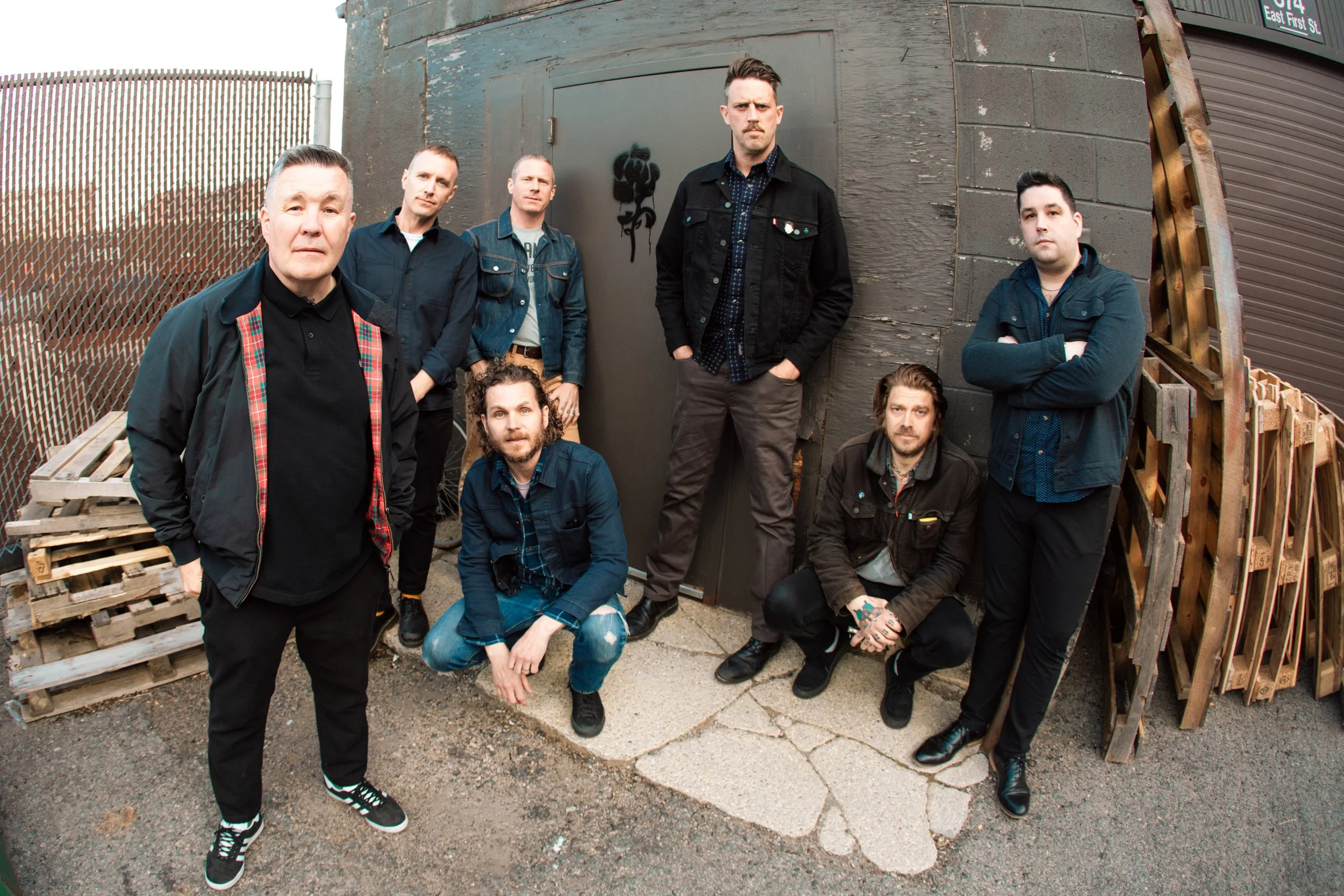
Courtesy: Dropkick Murphys
From the first European settlers in the 1700s to the huge wave of Irish immigrants coming to the city during the colonial period, today Boston still has the largest percentage of Irish descendants of any major American city. And Irish Americans are very proud of their heritage. Did you know that Boston has the most Irish pubs of any city outside Ireland, beating New York?² Much of the city of Boston was built with Irish labor, including Back Bay and the Boston subway system.
Though Irish culture in Boston did not knowingly influence the Dropkick Murphys at first, soon reviewers were comparing their singles to bands such as the Dubliners and the Ramones.³ Ken thinks it was because of their vocal delivery and the rambling quality of their songs. So they leaned into it.
“That [gave] us somewhat of a uniqueness to the band and also opened the doors to a lot of [new fans]. Even when we were more of a raging punk band, people would be like, ‘My father likes to come with me... because you do a couple of punked-up versions of traditional songs...’ People... could identify with that.”
And while they have played the 3Arena in Dublin and get a very good reception in Ireland, Ken believes the reason the Dropkick Murphys are so accepted there is because they have never pretended to be Irish, but have always been authentically who they are.
“I was always brought up in that mindset of, I’m an Irish American. My experience is what it is in Boston, not [in Ireland]. I feel like we got a little bit of respect for that, because that’s how we carried ourselves over there [in Ireland]. And it translates to Ireland just like it translates to England or Germany or whatever, because we’re talking about universal issues and universal causes.”
But when your band has skillfully danced the line between musical genres for years, it seems it can sometimes be frustrating to be labeled Celtic punk.
“We’d always get these reviews and we’d roll our eyes. It would say ‘Guinness-soaked punk rock,’ and I’d think, ‘I feel like we’re more like Budweiser-soaked punk rock!’ We’re always way more American. We are American... We’re an American band with the Irish influence, but not the other way around.”
Ken spoke passionately about the wonderful new wave of music coming out of Ireland.
“There’s a band called the Mary Wallopers... they sound so authentic... It’s timeless, is what it is. It really sounds so authentically old-fashioned, and I say that in a complimentary way... It’s so nice to see... younger bands that are kind of exploding.”
He also emphasized that if you are looking for more traditional music this St. Patrick’s Day, there are plenty of pubs with great trad bands playing. It is just not who the Dropkick Murphys are.
“We did always pride ourselves lyrically on documenting the experience of being Boston Irish... Same with New York, it’s a unique experience of how people came here...”
Irish immigrants were treated badly when they first arrived in America, with anti-Catholic and anti-immigrant sentiment growing. Many gained passage as servants and worked for years before earning their freedom, and there was much resentment in areas such as the previously Protestant Boston toward the large numbers of Irish Catholic immigrants embedding themselves in the community and getting involved in politics. JFK was the great-grandson of Irish immigrants.
“The Irish [have] always had more respect for our political messages than a lot of our fellow Americans have had.”
Well, Ireland has a long history of standing up against oppressive rulers. But, as Ken reminded me, people easily forget.
“I’m always so befuddled by how Irish Americans can support Donald Trump, and support what’s happening with immigration, and ICE... In a few short generations a lot of people forget how they got to where they are.”
Boston’s Irish Catholic paper The Pilot themselves said, “Unworthy descendant... is the man who earns his bread by sowing discord and brewing religious hate.”⁴ They were speaking of Republican George William Curtis’ implication that Irish Americans, and anyone not a direct descendant, could not celebrate the founding of America, but I think it remains particularly relevant.
St. Patrick’s Day began as a religious holiday in honor of Saint Patrick, who introduced Christianity to Ireland in the fifth century. Celebrations date as far back as the 1600s, but today St. Patrick’s Day is cause for celebration of all things Ireland. And as the day of green and clover approaches, the Dropkick Murphys are preparing for their concerts at Fenway Park.
When I asked Ken his favorite part of the annual tradition, he said simply, “It’s the homecoming.”
Every year they perform a series of concerts at home in Boston around St. Patrick’s Day.
“One of the downsides of touring as much as we do is you miss a lot of weddings, funerals, gatherings... because you’re away... Our whole lives come to us on that weekend. So, in addition to the fans that are there, our friends and family are there... We get to make up for a lot of lost time, and hang with a lot of good people...”
You would think, given their spontaneous conception and the larger-than-normal headcount of band members, that agreeing on ideas and writing hit songs would be difficult, but Ken says the Dropkick Murphys do not struggle with the creative process at all.
“We don’t really ever record unless we’re motivated and inspired... I remember at one point in our career we went four years without a record... a lot of us were starting to have children... We’re not going to put out an album that we don’t feel in our hearts.”
But personally, though he says it does work well, giving a song the chance to develop or being able to make changes before it goes public, Ken finds the recording process slower than he would like.
“I’m such an immediate-gratification guy... I love writing the songs and having the song develop, but then I want it out on an album the next day! [But] when you’re a seven-piece band, it takes a while... We’ll sometimes be in [the studio] a month...”
Even though they never go in to record without the full album already written. It is too risky to do otherwise, he says.
“I want to write the song, and have the people hear the song, and start singing along with us!”
Getting that feedback from live audiences is a big part of what keeps the Dropkick Murphys going thirty years later, even with the mental and physical demands of being on the road.
“[I] can say I played a show in New Zealand, or Russia, or Japan. I don’t know if I can narrow [my favorite] down to just one show... I would say places like Southern Europe, like Greece, the reception they give bands when they come there, it makes the hair on the back of your neck stand up... A passion that I’ve never seen anywhere!”
Ken told me that some of his favorite memories from their decades of touring have been getting to meet people of different cultures.
“Before the band I lived a fairly sheltered life in the sense that I wasn’t worldly, I hadn’t seen much other than Boston... To be able to look back and say not only do I get to do this as a career, but I get to say I’ve made friends in so many different countries [is great].”
When asked if he had ever been given a standout piece of advice, he told me a story about a German band called the Broilers, who they have been friends with for years and who started out in the same scene as the Dropkick Murphys.
“Sammy the singer said to me, and it’s funny because he’s probably younger than me, ‘Remember to focus on the people in the back of the room, and up in the balconies, and not just the people down front on the barricade with their fist in the air singing along, because those people paid the same money...’ And I was like, ‘Wow.’”
Ken was grateful for the reminder.
“To me, those people in the front, putting heart and soul into it in the pit, singing along, obviously that pumps us up and motivates us, but yeah, there might be people who love your music just as much... up in the balcony. Remember they’re there... And I’ve been doing this thirty years!”
That could almost be a lesson for the bigwigs who run the world today.
And while they are no doubt role models for younger bands, the Dropkick Murphys have not forgotten where they came from. They are enjoying the journey but never stop learning.
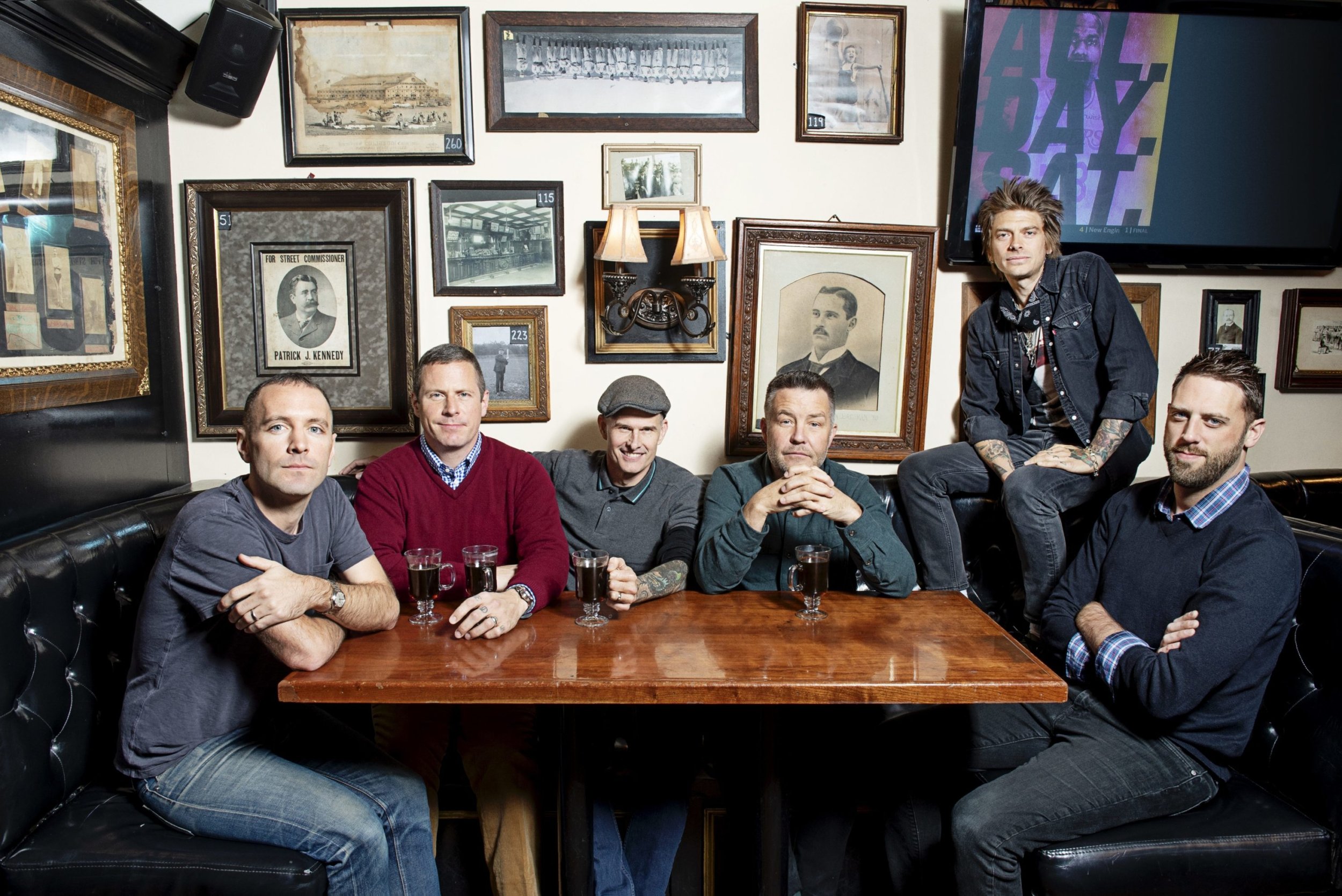
Courtesy: Dropkick Murphys
“I think in any career you have to always be willing to learn and grow. Especially in this day and age, the way the world’s changing so fast... By the same token, we are relearning some stuff back from [bands such as Haywire]. Get back down in the trenches a little bit.”
Ken chuckled about the boundless energy their opening acts have when they perform.
“They remind us so much of how we toured in the early days...”
But having seen the Dropkick Murphys myself less than a year ago, I told him they did not look too bad themselves for a bunch of old guys. Trust me and catch one of their shows. Their energy, and their message, is awesome.
“When we get on the stage we still feel like we give it 110 percent... but we play five nights a week... You get to a certain age and... just need a day off.”
Being on the road for so long has been an education in self-care, figuring out what their bodies need to survive touring.
“You have to know your limits... I [used to] be up and out in the morning, going sightseeing or playing golf, and I’m so glad I got that opportunity because I know so many bands who have only seen the world from backstage of the local barroom...”
Before the Dropkick Murphys, Ken had never been out of New England.
“It was [an] amazing opportunity. But nowadays it’s like, ‘Hey, you can’t burn the candle at both ends’... You gotta pace yourself...”
Ken says they all just try their best. Sometimes he misses the mark, and sometimes he manages to be well-rested.
He is also grateful for the opportunities the Dropkick Murphys have afforded him outside of seeing the world, such as the ability to provide for his children in a way he would not have been able to otherwise.
“I have three kids. It all [the band] happened during their lives, obviously...”
Though there were plenty of things he missed out on, Ken knows how great it was to have long stretches between tours to be present in their lives.
“I would make the comparison to being in the Merchant Marines. When I was gone, I was gone, and that was tough, especially on their mother. But when I was home, I got to have that real quality time.”
Most working parents do not have that.
The universal issues raised in their music are, I believe, part of why New York audiences respond to the Dropkick Murphys. We understand the struggle represented in a lot of their songs, the feeling of futility that comes with living amid the current political climate. It has become incredibly difficult for working-class Americans to survive. So many of us wrestle to make a decent wage. It feels as though the government has forgotten about us and is only interested in lining its own pockets. Landlord tax loopholes are making rent prices skyrocket. Families cannot afford groceries. Hell, it is still not affordable childless. Our hard-earned taxpayer money is going to support overseas nations like Israel, whose citizens already benefit from policies such as universal healthcare while our fellow Americans do not.
“Nowadays you look at a neighborhood like South Boston and nobody that grew up there can afford to live there.”
Cities like New York and Boston are pricing us out, even though there would be nothing left without us.
“I just saw a great quote today: ‘We need to measure how our economy is doing... by how the bottom third percent of the country does at the supermarket, not how the top one percent does at the stock market.’ And that is at the core of Dropkick Murphys’ message and always has been.”
The fearlessness of the Dropkick Murphys in changing their style depending on their current tastes, or what is going on in the world, has kept their music fresh and engaging. After the COVID-19 pandemic they recorded two acoustic albums of unpublished Woody Guthrie lyrics as a tribute, but they were eager to get back to their roots.
“I think by the time we were done being chained down to acoustic, which was fun, don’t get me wrong, but... between that and the political climate and how we [felt] inside, we were ready to be loud and angry.”
Speaking of the political landscape, a current common fallacy is that politics has no place in art, and artists should just shut up and play, or sing, or act, or paint. But art has always been inherently political. From ancient Greek poetry and Shakespeare’s commentaries on monarchs, to movie musicals such as Chicago and musicians like Billy Joel, art has always come from a longing to express how we are feeling about the world around us. And the Dropkick Murphys have never shied away from telling the truth of the populace. They are also passing the baton to younger bands.
“The band Slugger... from California, they’re [one of] the opening acts on tour with us right now... they’re very much activists out in the community. They’re such good kids... probably not selling much merchandise, but every night they’re donating proceeds of $150 to $200 from their merchandise sales to local causes... to people in the immigrant community who have been victimized by ICE. It’s so good to see that the next generation is carrying that banner.”
Much of the Dropkick Murphys’ catalogue reflects the lives of those around them, the working-class Americans and immigrants who love our country but are feeling drained and abused by the big machine. They have advocated for first responders, trade unions, military veterans, and children, and have spoken boldly about politics and our political representatives. Perhaps their longevity stems from the honesty in their music. It has always been for the people, and their message is that we cannot forget that the government works for us.
I asked Ken if it ever feels too tiring to continue in the face of the current social and political climate in the U.S. and across the world. His reply was that if it were easy, then it probably would not be needed at that moment.
“It’s when it’s more difficult... that it’s at its most important.”
His answer gives me hope that perhaps more people in positions of influence will step forward and stand up for the rest of us.
“The populations that have always been a big part of our audience... first responders, working class, Irish Americans... a lot of those people that came up lockstep with our beliefs, suddenly bought into the lie that billionaires... would take care of them better than anyone else. So it divided people, it divided our fan base... I just find it a lot easier to say, ‘Hey, we’re not the ones who changed, you did. Our message has never changed.’ You can talk hyperbole all you want, ‘Woke this, woke that.’ [Billionaires] will always stab you in the back. So I feel very comfortable in speaking out and saying, if you come at us for our beliefs, why didn’t you come at us when we sang these same beliefs in the ’90s and 2000s?”
Because you agreed with us then, he finished.
But the frustrating thing is, they do agree. I have seen it. They sing along and pump their fists with the music, the war cry of brothers in arms. But many are not living like they agree. They are working against their own best interests.
“For some people they do agree with the message... as long as we don’t attack the cult leader... If I say his [Trump’s] name, they come unglued... He’s a con artist. He’s ruined every business he ever touched... I hate to see what he has done to America.”
Ken believes we have fewer differences than we think. There are so many issues that should unite us.
“They want us all fighting amongst each other, while they’re stealing all the money out the back door. With career politicians on both sides there’s [always] been some of that.”
Look at the tariffs, for example, applied illegally, that cost hard-working Americans more money and put the country into greater debt now that we need to reverse them.
“As long as there’s big money, corporate interest... in politics, it will bring out the worst in a lot of human beings... And now on top of that with these [Epstein] files coming out... for Christ’s sake, can this be what finally makes us just come back together and say, ‘Hey, let’s stop looking left or right, let’s start looking up [for the problem]’?”
A lifelong Democrat, Ken has actually voted Republican once before, for the Republican governor in Massachusetts.
“I supported him because I know his character... He was very out in front of the opioid crisis... which at the time was killing a friend of mine a week, it seemed... But he also had the highest governor rating of any governor in America. But someone like him could never get out of a Republican primary if he ran for president.”
Ken believes the two-party system is broken and has led a lot of Americans to step away from politics and voting in general. But we need people to vote, to vote with their conscience, and to hold politicians to a higher standard.
“I think the biggest sign of... strong character at this point... is refusal to take money from big corporate interests and AIPAC... because it shows right off the rip that you’re willing to stand up for what you believe in and not be bought and sold... I don’t care how good they are and what they say, if they’re bought already by large corporate donations, [when] push comes to shove they’re not going to vote the way they need to [for the American people].”
The Dropkick Murphys are not afraid to put their money where their mouth is, either. They recently left their talent agency over the CEO’s inclusion in the Epstein files, which are proving to be one of the biggest scandals in modern history, showing proof of deep-seated corruption and abuse at the highest levels.
“This is at the heart of the problem in America. If people with skin in the game don’t take a stand, then how can they expect everyone else behind them to do it as well... Not that it was easy for us. We’ve been with our booking agents since before Wasserman [Music] had ever bought their company... No disrespect to our agents, no disrespect to all the great employees at Wasserman... We’ve never even met Casey Wasserman... But at the same time, we had to say to our agents, ‘Hey man, we’re not sitting around ’til you work this out.’ I do know that our agents will do the right thing, they’ll either make sure he’s completely divested from that company, or they’ll leave themselves, but we can’t wait around ’til they figure it out.”
Ken hopes other bands will follow suit, saying the bigger the band is, the less they need to stay, because they can get any agent they want.
“Our fans are our shareholders. They do hold us to accountability.”
He believes we should model ourselves on how other countries are handling those who have shown up in the Epstein files.
“It’s like BAM, immediate removal, moving to prosecution.”
How long until something is done about it here at home in America? Is this really how we want people in positions of power, in what used to be the greatest and most respected country in the world, to represent us?
Ken says the best part about being such a successful band is being their own boss and making their own decisions.
“We’ve always operated on the outskirts of the music industry. Even as we grew as a band, it kind of was a do-it-yourself thing... We’ve... kept it like a small family business... It’s nice to have that kind of control, and when you have that... you can get involved in a lot of passion projects. Like the Woody Guthrie record, or charity work, or saying what we want to say politically. It’s nice to have that freedom.”
While many Americans have been tricked into hurling their anger and fear at each other, conveniently distracted from those keeping us all down, the Dropkick Murphys have been giving back to the community through a charity they created called the Claddagh Fund.
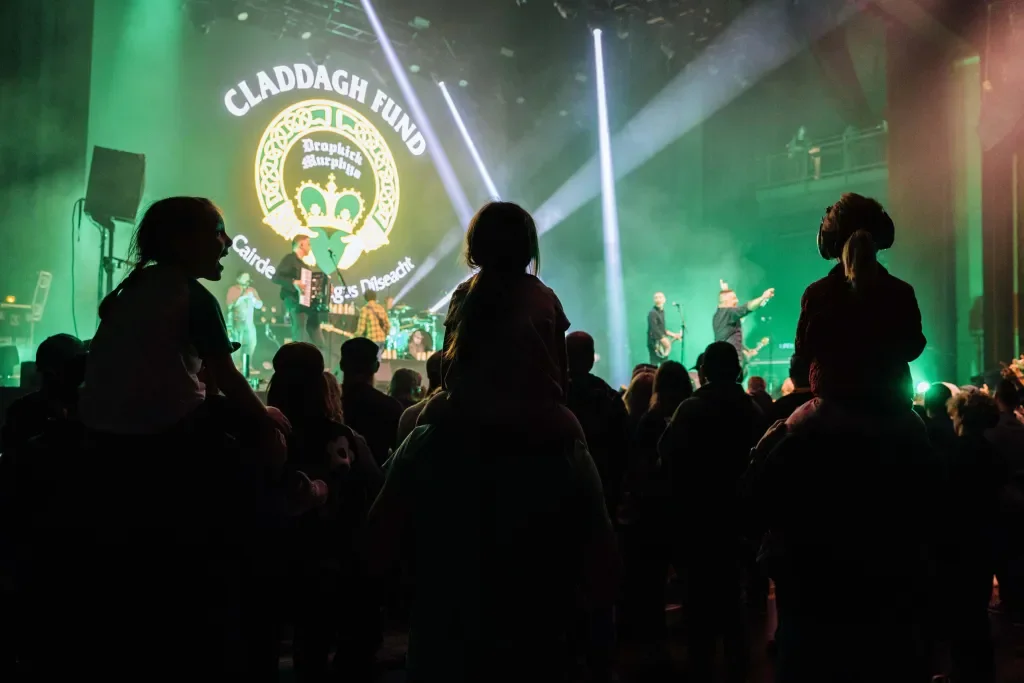
Courtesy: Dropkick Murphys
“The band was always involved in charitable stuff... Sometimes being in a band can seem like a selfish endeavor... and it felt like doing the charity stuff made the whole thing... more worthwhile.”
Founded in 2009, the Claddagh Fund began as a way for the band to get more involved in the communities they visit and honors the three attributes of the Claddagh Ring: Friendship, Love, and Loyalty. Today they support many different organizations with a focus on programs that support children, veterans’ organizations, cancer research, and alcohol and drug rehabilitation.
“Substance abuse treatment, and helping others with alcoholism and substance abuse, is one of the main things we focus on, and it’s been something that has personally impacted many of our lives. Whether it’s the individual band members... like myself, who were sober before the band even started, or guys who have got sober along the way, or all the loved ones and friends that we’ve lost to overdoses throughout the years... It was just a subject near and dear to our heart.”
They even raised over $100,000 for victims of the Boston Marathon bombing.
Their mission is to raise money for community-based nonprofits, to support the most vulnerable individuals in our communities who are largely forgotten by government aid. As of 2022, the Claddagh Fund had raised more than $5 million.⁵ You can find ways to donate, purchase merch, or see their upcoming events and fundraisers at claddaghfund.org.
When I asked Ken the best parts about visiting NYC, he laughed and said New York has always treated the Dropkick Murphys “like a cousin they couldn’t stand,” and said one of his favorite things to do in the city is talk shit about the Yankees.
“We’ve always enjoyed a back and forth with New York... [It’s] always fun... rivalries to a degree but always a lot of love and shared similarities... New York is one of those cities...”
It is a friendly rivalry, he said. Like the ad, “Your cousin from Boston.”
He reminisced about the early days playing venues down in St. Mark’s Place.
“One night [I watched] Joey Ramone walking down the street with one of our soccer jerseys that he bought... I said to our merch guy, ‘You better have given that to him’... He goes... ‘He insisted on buying it.’ New York was one of those places that we were going and doing underground shows... long before we were a real touring band.”
I asked Ken to tell me more about the punk scene, what it was like, whether it was ultra-competitive between the bands.
“It was like family... A total sense of community... The godfathers of New York hardcore, Agnostic Front, took us on one of our very first full U.S. tours... in 1997... Once you had the blessing of Agnostic Front, New York treated you well, no matter what.”
In terms of his favorite NYC venues, he emphasized how great the punk spots were back in the day, such as CBGB, Wetlands Preserve, and Coney Island High.
“We also used to have amazing shows at the Roseland Ballroom, which is no longer there... We’ve just got some great memories in New York all around.”
But then Ken left memory lane and gushed about a contemporary site, Pier 17.
“Outside with the Brooklyn Bridge behind you, I don’t know how you can top that venue. That’s about as good as it gets for a band if you ask me. Just being able to be on stage and look around at the city and the water. It’s just amazing!”
Sidenote to our readers: having had the opportunity to see two concerts at the Rooftop at Pier 17, one of which was a Dropkick Murphys show, I highly recommend it. It is a stunning NYC venue that advertises a long list of visiting artists every summer.
His favorite restaurant, though he despairs that it got sold and thinks it may now be corporate, was Quality Meats.
“...right up by Central Park. I love that place... [And] somewhere down in Little Italy, there’s a bunch of small mom-and-pop joints. I can’t even remember their names... But Vinnie Stigma from Agnostic Front was a Little Italy guy, showed us all the best of the best.”
Italian is Ken’s favorite food to get while in NYC.
“That’s where all my memories are at.”
As for what is next for the Dropkick Murphys, Ken says they never look that far into the future. They take it a day at a time.
“Put your best foot forward. You never know what tomorrow may bring... At this point, I say we look more toward not so much growing as a band as we do protecting the legacy of the band... making sure we stay true to what we’re about.”
And I think that is admirable.
For a band whose music has always been for the people, their accessibility to their fans has been the most important thing to them.
“I like to say I’ve probably [shaken] 80 percent of the hands of the people who have come to Dropkick Murphys over the years, because... we want to meet and know the people who have given us this amazing opportunity... If it wasn’t for the people, we wouldn’t be doing it. We wouldn’t be able to...”
The Dropkick Murphys are for the fans. For the people. Since 1996.
For the People is the thirteenth studio album by the Dropkick Murphys, released in July 2025. They have a split LP with Haywire available at any of their shows, becoming commercially available via retail and streaming right around St. Patrick’s Day. Ken kindly asks that you visit claddaghfund.org to see how you can help with their mission.
References
https://www.bu.edu/articles/2025/alums-new-documentary-celebrates-bostons-once-thriving-punk-scene/
https://revuewm.com/music/dropkick-murphys-keep-the-style-pump-up-aggressive-sounds
“Unworthy of Concord,” The Pilot, May 1, 1875, https://newspapers.bc.edu/?a=d&d=pilot18750501-01.2.19&e=-------en-20--1-txt-txIN-------,%2c4,4
https://www.wcvb.com/article/dropkick-murphys-2022-claddagh-fund-golf-tournament/41111519
Other References
claddaghfund.org
https://www.bostonartreview.com/read/michael-grecco-anderson-yezerski-olivia-deng
https://www.bu.edu/articles/2025/alums-new-documentary-celebrates-bostons-once-thriving-punk-scene/
https://shitenonions.home.blog/2019/11/19/dropkick-murphys-the-meanest-of-times-review-1/
https://globalboston.bc.edu/index.php/home/ethnic-groups/irish/
https://www.nps.gov/articles/000/irish-claims-to-the-revolution.htm
https://www.bostonglobe.com/2026/02/12/arts/dropkick-muprhys-wasserman-agency-epstein/