How America Keeps Rewriting Itself: Inside NYPL's Declaring America
Hidden among 250 years of letters, maps, photographs, and protest artifacts is a reminder that America has always been unfinished. NYPL's Declaring America traces the nation's story not as a straight line, but as an ongoing debate.
Commemorating the 250th anniversary of the signing of the Declaration of Independence and the birth of the United States, the New York Public Library has unveiled a new exhibition exploring the powerful and diverse stories of the American Revolution, from 1776 to the present day. Free to the public, Declaring America: 1776 and Beyond opened on June 15 and features approximately 250 items from the Library's own collections.
Spanning two floors and multiple galleries of the Stephen A. Schwarzman Building on Fifth Avenue, the exhibition traces New York City's role in America's coming of age through revolution, protest, and art. Tawk was fortunate enough to be invited to a private preview of the exhibition before it opened to the public.
While everyone knows the iconic lions out front, not many get to experience the beauty of the cavernous space unencumbered by crowds. The quiet reading rooms and glorious architecture, all nestled in the heart of our bustling city, are a large part of what makes this landmark so special and such a sought-after destination for locals and tourists alike. It is also a fitting home for such a monumental celebration, which includes a facsimile of Jefferson's original handwritten draft of the Declaration of Independence. (The actual original will be on display during the week of July 4. Visitors can access free timed tickets for the rare public viewing at NYPL.org.) There are only a few surviving copies of the more than 250-year-old document in the entire world.
Julie Golia, the Linda May Uris Director at the Humanities and Social Sciences Research Library and one of the organizers of Declaring America, has been working on the exhibition for three years, remarking that it was "...daunting to unspool, untangle and explore 250 years of history in the way that only NYPL can." She explained that their inspiration came from the iconic and complicated Declaration of Independence.
"These [documents] were written at a time when notions of equality were not a part of people's lives... Generation after generation have taken up that debate and continue to have those conversations today. We are committed to [encouraging that] in these galleries and beyond."
From letters and maps to colonial newspapers, pamphlets, posters demanding rights, signs denouncing political opponents ("A crisis a day is the dictator's way..." hmmm), wearable textiles, dance pieces, photography, and even a Spotify playlist of protest music, the exhibition represents all parts of the United States. From Indigenous Americans and Black Americans to Founding Fathers and immigrants, the pieces have been carefully chosen not only for their significance in illustrating the foundations of our country, but also to reflect how fluid and ever-changing the American landscape is. It is incredible that these documents have survived and continue to be preserved by the library.
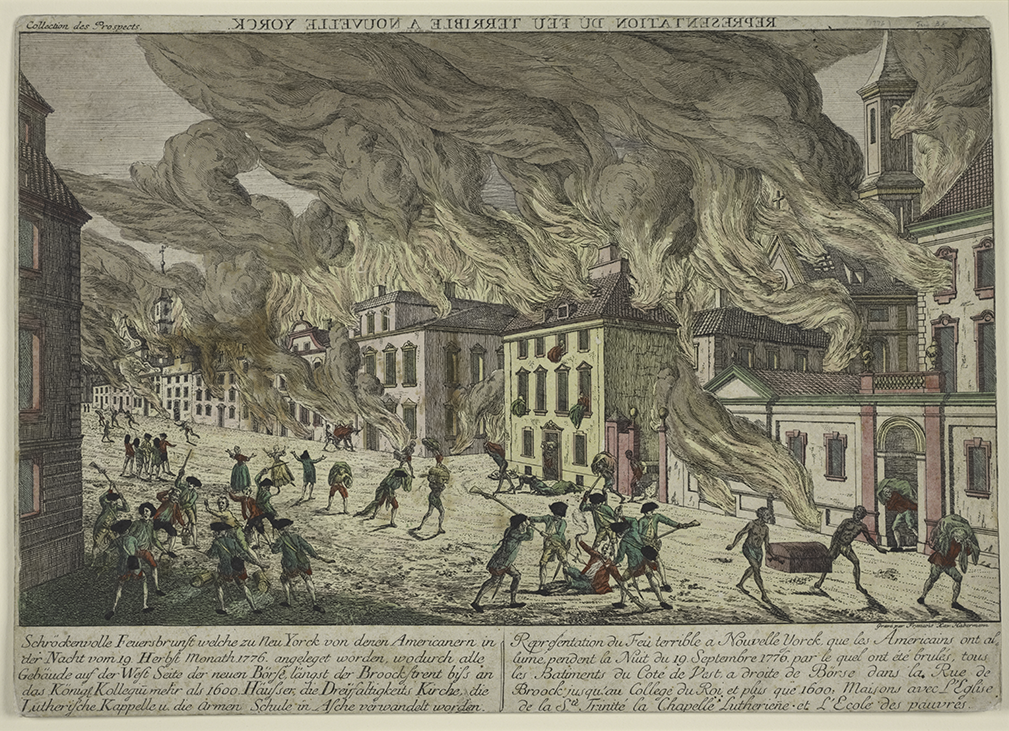
Per the NYPL: One of the most reproduced and recognizable images of the Great Fire of 1776, Habermann’s view is rife with Royalist propaganda, including images of looters ransacking burning buildings as angry mobs beat British soldiers in the streets. Mirroring reports of the fire in the British press, Habermann laid the blame squarely on the Americans in the title of his engraving, Representation of the terrible fire at New York, which the Americans lit during the night of September 19, 1776.
- Franz Xaver Habermann, engraver, Representation du Feu Terrible a Nouvelle Yorck… (Representation of the Terrible Fire in New York…), engraving, 1776
With galleries dedicated to the American Revolution, the history of protest in the United States, and the ways American artists have interpreted these historic moments, Declaring America shines a light on stories of strength, resilience, and determination that exemplify the American spirit. The exhibition explores struggles for voting rights, civil rights, labor organizing, and political movements.
One such story is that of activist and LGBTQ+ community leader Barbara Gittings. Widely considered the mother of the LGBTQ+ rights movement, Gittings founded the New York chapter of the Daughters of Bilitis in 1958 and became editor of The Ladder in 1963. Alongside gay rights leader Frank Kameny, she helped organize the first annual demonstrations, known as "Reminder Days," advocating for gay and lesbian equality beginning in 1965. These demonstrations helped pave the way for the modern Pride celebrations we know today.
In the early 1970s, Gittings successfully lobbied the American Psychiatric Association to remove homosexuality from its list of mental disorders. Her hand-sewn dress, created to comply with Kameny's standard of "squeaky-clean respectability," is on display in the section of the exhibition titled The Pursuit of Liberty. She wore the dress during the final march outside Independence Hall in Philadelphia in 1969, before activists moved their commemoration efforts to New York City on the first anniversary of the Stonewall Riots.
With the goal of making information freely accessible to everyone, not just the privileged few, Benjamin Franklin, one of the Founding Fathers and a member of the Committee of Five tasked with drafting the Declaration of Independence, helped establish one of America's first public libraries in 1731.
Tony Marx, President of the New York Public Library, stated that "Everything in the exhibit belongs to the people of New York," and emphasized the importance of libraries across America.
"[We] hope you'll see in these galleries that the feelings and struggles of today are not unique. The world is scared and divided. But we have been through hard things before and got through it... Working together toward shared ideals is the miracle of democracy."
That concept could not be more American.
The organizers of Declaring America invite visitors to celebrate the nation's 250th anniversary by visiting libraries across the country, where they can learn, become more informed, and become better members of their communities. Because knowledge is power.
"Our mission is what we can uniquely offer... We are a convener of people, of debate... We want people to come and engage in civic debate. We are also collectors, and we take this work equally as seriously, dedicating ourselves to gathering pieces of history," Golia concluded.
Having access to this history reminds us of the eras of colonialism, inequality, and civil conflict in our past, but also of our shared heritage. The idea of shared heritage has never felt more important. Our history, no matter where we come from, is one shared story, and places such as the New York Public Library play a vital role in preserving it.
The journey of America's birth into independence is not only integral to the story of the United States and its people, but also deeply similar to the stories of nations around the world. We share much common ground, and we all seek the same fundamental rights: life, liberty, and the pursuit of happiness.
Declaring America: 1776 and Beyond, curated by Jason Baumann, Charles Cuykendall Carter, Clare Bell, Elizabeth C. Denlinger, Ian Fowler, Julie Golia, Tammi Lawson, Whitney Lee, Meredith Mann, Linda Murray, and Maggie Mustard, will run at the New York Public Library through January 10, 2027.